
Module 4 · Reading & Listening Strands · Lesson 16
Speaking Part 2 Long Turn
Comparing photos with timing and stance
Get talking · Section 1
4 minGet talking
Look around the room. Pick TWO objects. In 10 seconds, say one thing they have in common and one way they differ. Don't think — speak.
Your teacher shows a photo of a stranger. In 20 seconds, speculate about their job and their morning — using language that DOESN'T claim to know.
A candidate spent 60 seconds describing two photos in detail. The examiner gave 3/5. Why? What did the candidate forget to do?
Speculation modals, adverbs and comparative frames
Quick rule
Part 2 is not description. Use SPECULATION (may / might / could / must / can't be) and COMPARISON FRAMES (whereas, while, unlike, in contrast) — not 'there is / there are'.
Cambridge wants to hear hypothetical, speculative, comparative language at C1. 'There is a man in the first photo' earns nothing. 'The man in the first photo seems to be on his way to work, whereas the woman in the second looks as if she's just finished a long shift' uses speculation ('seems to', 'looks as if'), comparison ('whereas'), and answers an implicit question (who is each person, what are they doing). Train: modals of deduction (may / might / could for open, must / can't for confident), adverbs of degree (presumably, arguably, conceivably) and comparison connectors (whereas, while, unlike, in contrast, similarly, equally).
Examples
Open speculation: 'She MIGHT be a freelancer — there's no uniform.' (open, ~50% confidence)
Confident deduction: 'He MUST have been working for hours — the desk is covered in cups.' (confident, ~90%)
Comparison frame: 'WHEREAS the first photo is clearly staged, the second looks spontaneous.'
Hedged comparison: 'Both seem to be experiencing pressure, ALTHOUGH in very different ways.'
Quick check
Question 1.Pick the most appropriate frame for OPEN speculation about a stranger in a photo:
Question 2.Which sentence shows CONFIDENT deduction with evidence?
Question 3.Which connector best signals CONTRAST between two photos?
Question 4.'Both photos show people under pressure, ____ in very different settings.' Best fit:
Question 5.An examiner hears 60 seconds of pure description. Why is the score likely to be 3/5, not 5/5?
Build the sentence → spot the natural chunks → say it aloud → reply like a real conversation.
1.Build an OPEN speculation about a stranger, based on visible evidence.
2.Build a CONFIDENT deduction with evidence (five cups on the desk).
3.Build a CONTRAST frame comparing two photos.
Words & phrases to own
to seem / appear to be
to look like something is the case — hedged
e.g. She seems to be enjoying it, although it's hard to tell from her expression.
Use it now
Describe a photo of a colleague using 'seems to' twice.
↻ Recycled in listening · speaking
presumably
I assume, based on what I can see — hedged but confident
e.g. Presumably, the meeting is just starting — they've all just sat down.
Use it now
Use 'presumably' to explain something you can SEE but don't KNOW.
↻ Recycled in speaking · writing
in contrast / by contrast
marker of strong difference between two things
e.g. The first photo is highly formal; the second, by contrast, is almost playful.
Use it now
Compare your weekday and weekend mornings using 'by contrast'.
↻ Recycled in writing · speaking
what strikes me is
what stands out / what I notice — natural opener
e.g. What strikes me about both photos is the lack of eye contact.
Use it now
Look at any two photos in your phone — open with 'what strikes me is…'.
↻ Recycled in speaking · homework
arguably
you could make a case that — sophisticated hedge
e.g. Arguably, the second photo captures the more honest moment.
Use it now
Make: 'Arguably, ______ is the more ______ of the two.'
↻ Recycled in speaking · writing
to capture (a moment)
to record or convey something fleeting (photo lexis)
e.g. The photographer has captured a moment of complete exhaustion.
Use it now
Describe a photo you love using 'captures a moment of ______'.
↻ Recycled in speaking · homework
Tap an item on the left, then tap its match on the right.
Pair / group discussion
- Which of today's items would feel MOST natural to drop into a Part 2 long turn for you? Which feels forced?
- Pick a photo on your phone. In 30 seconds, describe it using at least THREE of today's items.
Complete each stem about yourself
- What strikes me about the first photo is ______.…
- By contrast, the second photo ______.…
- Arguably, the photographer has captured ______.…
Rank & justify
Rank these from MOST to LEAST useful in the first 10 seconds of a Part 2 long turn.
- What strikes me is…
- Both photos show…
- Presumably…
- There is a man…
Quick write (60 seconds)
In 2 sentences, compare two contrasting photos from your own life using at least two of today's items.
Pronunciation · Section 4
3 minProminence on the contrast word
In comparison sentences, the STRESS lands on the CONTRAST word — that's what the examiner's ear is tuned to. 'The FIRST photo is FORMAL, whereas the SECOND is COMPLETELY relaxed.' Drill aloud: contrast pairs get the prominence.
- The FIRST photo is FORMAL || WHEREAS the SECOND is RELAXED.
- BOTH photos show PRESSURE || but in VERY different SETTINGS.
- She SEEMS to be ENJOYING it || ALTHOUGH it's HARD to TELL.
- PreSUMably the MEETing || is JUST STARTing.
Reading · Section 5
8 minBeyond the Frame: The Power of Speculative Vision
The evolution of visual storytelling has fundamentally altered how we perceive the world around us. In the past, a photograph was often viewed as a definitive record of a moment—a static piece of evidence. However, modern sensibilities have shifted, moving away from the rigid documentation of the 'say cheese' era towards a more nuanced appreciation of light, shadow, and subtext. What strikes me is the way contemporary audiences have become sophisticated consumers of imagery; they no longer require a photo to provide all the answers. Instead, the most compelling images are those that leave room for the viewer to speculate on the narrative beyond the frame.
When we look at a candid shot of a busy market, for instance, we are not merely observing a transaction. We are drawn into the atmosphere—the heat, the noise, the potential tension between the vendor and the customer. Arguably, the power of such an image lies in its ability to capture a moment that appears to be entirely unmediated. Unlike the formal portraits of the nineteenth century, which were designed to project a specific social status, modern street photography seeks to find beauty in the mundane. By contrast, a staged corporate headshot may offer clarity, but it often lacks the soul that an accidental' snapshot possesses. The subject in the former must be composed and professional, whereas the subject in the latter might be caught in a fleeting expression of doubt or joy.
This shift has led to a new vocabulary of visual comparison. We find ourselves constantly weighing the 'authentic' against the 'curated'. Presumably, the rise of social media has accelerated this trend, as individuals become the architects of their own visual identities. Yet, even in this era of digital manipulation, we are still haunted by the 'decisive moment'. A photographer might spend hours waiting for a single alignment of elements that seems to be a stroke of luck, but is actually the result of immense patience and technical skill. The photograph doesn't just record the scene; it interprets it.
Furthermore, the act of comparison serves to highlight what is absent as much as what is present. When we place a contemporary image of urban decay alongside a historical photo of the same street in its prime, the contrast is jolting. It forces us to confront the passage of time and the fragility of human structures. In this context, the photograph becomes a tool for philosophical inquiry. We must ask ourselves: what has been lost? What has been gained? The emotional labor of the observer is what breathes life into the still image, transforming a simple arrangement of pixels into a profound statement on the human condition.
Ultimately, the ability to 'read' an image is as vital as the ability to read a text. We must be able to look at two different depictions of the same theme and identify the subtle shifts in perspective that change our emotional response. Whether it is the play of light on a subject’s face or the inclusion of a telling detail in the background, every choice made by the photographer is an invitation to the viewer. To capture a moment is one thing; to imbue it with a lasting resonance that invites endless speculation is the mark of true artistry. As we navigate an increasingly visual world, our capacity for comparison and critical analysis remains our most valuable asset.
Question 1.What is the central argument of the first paragraph?
Question 2.According to the second paragraph, why is 'true' authenticity difficult to achieve?
Question 3.What role do 'staged' or historical portraits play in the author's analysis?
Question 4.What does the phrase 'the emotional labor of the observer' imply in the fourth paragraph?
Question 5.What is the author's conclusion regarding the 'act of seeing'?
Question 6.The overall tone of the text expresses an interest in...
Q1.The author suggests that the value of a photograph is partly determined by what it leaves unsaid.
Q2.The text argues that nineteenth-century portraits were more honest than modern street photography.
Q3.The author believes that 'accidental' snapshots can have more emotional depth than professional portraits.
Q4.According to the passage, the 'decisive moment' in photography is almost entirely a matter of luck.
Listening · Section 6
8 minThe Art of the Candid Shot
Listening audio
Tap play to listen. Replay as many times as you need.
Show transcript
Callum (Scottish, m):Welcome to 'Digital Perspectives'. Today I'm joined by Dr. Isla Graham, a specialist in visual sociology.
Isla, we’ve been looking at how photojournalism has shifted towards candid, unposed shots. What strikes me is how much we now value the 'unfiltered', even when it's clearly staged.
Isla (Scottish, f):It's a curious paradox, isn't it? We crave authenticity, yet we're more aware than ever of the 'frame'. If you look at two contrasting images of the same event—say, a politician at a rally versus a quiet moment backstage—the latter arguably carries more weight now.
It seems to be a reaction against the polished veneer of traditional PR.
Callum (Scottish, m):But surely even that backstage shot is a form of performance? I mean, the subject presumably knows the camera is there. They might be consciously projecting a 'relatable' persona.
We shouldn't necessarily take it at face value.
Isla (Scottish, f):Oh, absolutely. It's rarely a 'fly-on-the-wall' situation in the purest sense. However, in contrast to the rigid hierarchy of 20th-century portraits, modern photography thrives on that ambiguity.
When we compare a set-piece photo with a candid one, our brains engage more because we have to speculate about the subject's internal state. '.
Callum (Scottish, m):I suppose that’s why some people find modern street photography intrusive. It’s trying to capture a moment that was never meant for public consumption. Unlike studio work, where there’s a contract between subject and photographer, here it's more of a...
well, a theft?
Isla (Scottish, f):That's one way of looking at it, though I'd hedge that by saying it depends on the intent. In a studio, the lighting must be perfect, the pose must be struck. Whereas in the street, the power lies in the transience.
The photographer can't be sure of the outcome. That uncertainty is what makes the final image so much more evocative than something manufactured.
Callum (Scottish, m):You mention evocative, but don't we risk over-interpreting? If we see a person looking pensive on a bus, we might assume they're undergoing a life crisis, when in fact they're just wonderingly what to have for dinner! Is there a danger in this trend of 'deep' speculation?
Isla (Scottish, f):Perhaps, but that’s the beauty of it. The image serves as a mirror for our own preoccupations. A photo doesn't just show a person; it shows our relationship with the idea of that person.
That's why comparison is such a vital tool in visual literacy. By looking at two similar scenes through different lenses, we reveal our own biases.
Callum (Scottish, m):Right. So, it's not so much about the objective truth of the moment as it is about the narrative we construct around it?
Isla (Scottish, f):Precisely. We aren't just passive observers anymore; we’re active participants in the storytelling process. Even a seemingly mundane shot of a rainy street can be elevated to high art if the viewer is given enough room to speculate.
Callum (Scottish, m):It’s a far cry from the 'say cheese' era of photography, that’s for sure. Isla, thank you for sharing your insights.
Isla (Scottish, f):A pleasure, Callum. Just remember, next time you see a 'candid' shot, it might not be as spontaneous as it appears to be!
Question 1.What paradox regarding modern photography do the speakers discuss?
Question 2.Why does Isla believe candid photos are more engaging than 'set-piece' ones?
Question 3.When discussing street photography, Callum's tone suggests...
Question 4.What does Isla identify as the primary difference between studio and street photography?
Question 5.What is Isla's view on the potential for 'over-interpreting' a photograph?
Question 6.In her final remark, Isla appears to be...
Question 1.Overall, what is Isla's attitude toward speculating about candid photographs?
Visual stimulus · Section 7
3 minSpeaking Part 2 — the photo pair and the printed question
This is the kind of stimulus you'll see on the page in Part 2. The PRINTED QUESTION above the photos is the answer requirement — not the photos themselves.
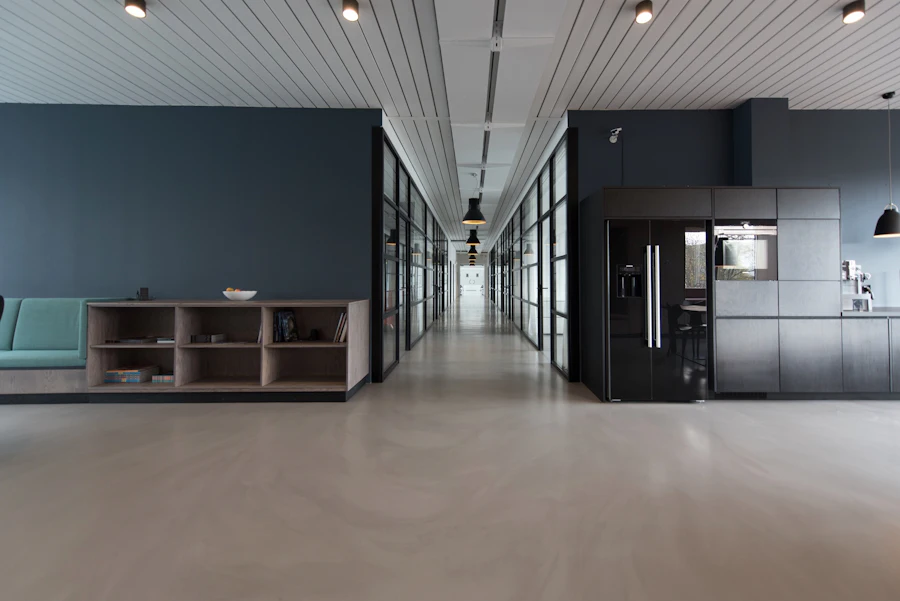

Notes
1-minute Part 2 frame
- ▸0:00–0:10 — Open with a comparison or a 'what strikes me is…' (NOT description).
- ▸0:10–0:30 — Speculate about Photo A — WHY this person might have chosen it.
- ▸0:30–0:50 — Speculate about Photo B — WHY this person might have chosen it, using a contrast frame.
- ▸0:50–1:00 — Brief personal angle / which would suit YOU and why.
Discuss in pairs
You have one minute. Compare the two photographs and say WHY MIGHT each person have chosen this kind of working environment? You don't need to describe the photos in detail — speculate and compare.
Speaking Part 2 — long turn, 1 minute on two photographs
Strategy
- 1.(5s pre-turn) READ THE PRINTED QUESTION FIRST. It controls everything you say.
- 2.Open with comparison or 'what strikes me is…', NOT 'there is / there are'.
- 3.Speculate, don't claim. Use seems / presumably / might / could / must.
- 4.Use ONE contrast frame (whereas / by contrast / unlike) when you move between photos.
- 5.End with a 5–10s personal angle — it shows engagement, not just analysis.
- 6.Don't try to describe everything. Half the photo detail with twice the speculation = higher band.
Example
Strong opener: 'What strikes me about both photos is that each person seems to be making a deliberate choice about CONCENTRATION. The man in the first photo presumably wants the imposed order of the office, whereas the woman in the café might actively need the buzz around her to focus. Personally, I'd find the second easier on a tired day.' (Comparison + speculation + contrast frame + personal angle — all in ~30 seconds.)
Practice · Section 9
7 minFill in the blank
Question 1.She ____ to be enjoying it, although it's hard to tell from her expression.
Question 2.The man must have been working for hours — there are five empty cups on his desk. ____, he hasn't moved.
Question 3.The first photo is highly formal; the second, by ____, is almost playful.
Question 4.What ____ me about both photos is the lack of eye contact.
Question 5.____ , the photographer has captured the more honest moment in the second photo.
Question 6.The first man is clearly in a corporate setting, ____ the second seems to have chosen the café herself.
Q1.Complete Isla's phrase (max 3 words): modern photography thrives on that ______.
Q2.Complete Callum's comparison (max 3 words): unlike studio work, street photography feels more like a ______.
Q3.Complete Isla's claim (max 3 words): the image serves as a ______ for our own preoccupations.
Q4.Complete Isla's closing remark (max 3 words): a 'candid' shot might not be as ______ as it appears.
Writing · Section 10
4 minPut it in writing
Your task
Write the SCRIPT of your own 1-minute Part 2 long turn (~140 words) for the photo pair on this page. Use AT LEAST four of today's vocabulary items, ONE speculation modal and ONE comparison frame. Mark the timestamps (0:00 / 0:30 / 0:50) where each section starts.
- • ~140 words = roughly 1 minute spoken at natural pace.
- • Open with a comparison or 'what strikes me is…', NOT 'there is / there are'.
- • Speculate, don't describe. End with a 5–10s personal angle.
Before you submit
- ☐ Answers the PRINTED question (about WHY each person chose this environment).
- ☐ Uses at least 4 of today's vocabulary items.
- ☐ Includes at least 1 speculation modal and 1 contrast frame.
- ☐ Has a clear 4-part structure: open → photo A → contrast into photo B → personal angle.
Show model answer
(0:00) What strikes me about both photos is that each person seems to be making a deliberate choice about how to concentrate. (0:10) The man in the first photo is almost certainly in a corporate office — presumably he didn't choose the space himself, but he seems to value the imposed order: everything is on the desk for a reason, and his posture suggests hours of routine. (0:30) The woman in the second, by contrast, has clearly opted in. She might be a freelancer who finds silence stifling, or arguably someone who feeds off the buzz of strangers around her. (0:50) Personally, I'd find her environment harder on a tired day, but on a creative one I can see exactly why she's captured something the first photo couldn't. (147 words)
Make it a real conversation
Speaking Part 2 — timed pair delivery. 10 minutes. In pairs: Student A delivers their 1-minute long turn on the photo pair above (partner times them on a phone, then asks the ~30s follow-up: 'Which environment would YOU prefer?'). Swap roles with a SECOND photo pair from the board below. Debrief: did each speaker compare, speculate AND answer the printed question?
Choose ONE alternative photo-pair theme for the swap round. Same 1-minute rules apply.
Why might each person have chosen this kind of LIFESTYLE / MOMENT / ENVIRONMENT?
Two commutes
Crowded train vs. solo cyclist — why this commute?
Two meals
Family dinner vs. solo desk lunch — why this way of eating?
Two holidays
Group tour vs. solo hiker — why this kind of break?
Two classrooms
Traditional rows vs. open-plan learning space — why this style?
Useful phrases
- What strikes me about both photos is…
- The first photo presumably shows…
- By contrast, the second seems to…
- She might be ______, or arguably ______.
- He must have been ______ — you can see ______.
- Personally, I'd find ______ because ______.
- AWhat do you notice about these two photos?
- B_______________
- ADo you think the woman in the café is a freelancer?
- B_______________
- AHow do the two settings differ?
- B_______________
Optional · Teacher-led
Teacher Activities
Stretches if time allows. All work fine 1:1. ~16 min total
Homework · Section 12
Take-homeTake it home
Record yourself doing TWO 1-minute Part 2 long turns on two different photo pairs you find online. Time yourself strictly. Listen back and tick: (a) did I compare? (b) did I speculate? (c) did I answer the printed question? (d) did I add a personal angle?
Write a second 1-minute script (~140 words) for ONE of the swap-round prompts (Two commutes / Two meals / Two holidays / Two classrooms). Same checklist: 4 vocab items, 1 speculation modal, 1 contrast frame, printed-question answered.
Find ONE short YouTube interview (~3 mins) with anyone you find interesting. Transcribe the FIRST 60 seconds of any answer they give. Identify: speculation language, comparison frames, personal-angle sentences. This is the natural-English source of Part 2 lexis.
For each of today's 6 vocab items, write (a) one collocation, (b) one natural example in YOUR own voice, (c) one Part 2 sentence you would actually say. Keep this as a Part 2 phrase bank.
Recap · Section 13
Wrap-upWhat you've learned
- Part 2 is comparison + speculation + the printed question — NOT description.
- Open with 'what strikes me is…' or a comparison, never 'there is / there are'.
- Speculation modals (might / may / could / must / can't) and adverbs (presumably, arguably) carry the C1 mark.
- One contrast frame (whereas / by contrast / unlike) shapes the move from photo A to photo B.
- End with a 5–10s personal angle — it shows engagement and lifts you from Band 4 to Band 5.
Need more practice?
Extra Practice for the task types and language in this lesson. Optional — it never changes your progress.
Lesson complete
Mark this lesson done to save your progress.