
Module 1 · Foundations of CAE · Lesson 01
Welcome to CAE
The exam, the journey, your starting voice
Get talking · Section 1
4 minGet talking
Give your partner one professional, one academic and one personal reason for taking CAE now.
Road, mountain, doorway or stadium — which is your CAE journey? Be specific.
List every CAE paper you can name and one thing you think each tests. Compare in pairs.
Hedged self-description
Quick rule
Soften absolute statements with degree adverbs (broadly, largely) + modals (would, tend to) + frequency phrases (more often than not).
At C1, Cambridge rewards precision and stance — not louder claims. Strong candidates hedge: they soften absolute statements with degree adverbs (broadly, largely, particularly), modal verbs (would, tend to, can), and frequency phrases (more often than not, on the whole). Combined with accurate present simple vs. present continuous, this lets you talk about yourself flexibly without overclaiming.
Examples
I tend to be quite methodical, particularly under pressure.
On the whole, I'd say I'm getting more comfortable with public speaking.
I wouldn't describe myself as outgoing exactly, but I'm more sociable than I used to be.
I'm largely self-taught, although I'm currently doing a short course on the side.
Quick check
Question 1.'I ___ I'm fairly patient, although it depends on the situation.'
Question 2.Which sentence hedges most effectively?
Question 3.'These days, I ___ more time on creative writing than I used to.'
Question 4.'I'm ___ comfortable speaking English in meetings, but presentations still make me nervous.'
Build the sentence → spot the natural chunks → say it aloud → reply like a real conversation.
1.Rebuild a hedged self-description.
2.Rebuild a present-continuous habit-in-progress sentence.
Quick check 1.Which is more C1: 'I love English.' or 'I'd say I'm genuinely interested in how English works.'?
Words & phrases to own
broadly speaking
in general terms; with some exceptions (hedge)
e.g. Broadly speaking, I prefer working in small teams.
Use it now
Finish this out loud: 'Broadly speaking, my approach to deadlines is…'
↻ Recycled in Speaking task & 220-word homework
to tend to (do)
to usually do, as a tendency rather than a fixed habit
e.g. I tend to overthink emails before sending them.
Use it now
Tell a partner two things you tend to do at work or in study.
↻ Recycled in Conversation section
more often than not
usually, in most cases (softer than 'always')
e.g. More often than not, I'd rather listen than talk in a meeting.
Use it now
Complete: 'More often than not, on a Sunday evening I…'
↻ Recycled in Writing homework
to come across as
to give the impression of being (a certain kind of person)
e.g. I come across as quiet, but I'm just thinking.
Use it now
Ask your partner: 'How do you think you come across to new colleagues?'
↻ Recycled in Speaking & Exam Review Lab
level-headed
calm and sensible, especially under pressure
e.g. She stayed level-headed when the client changed the brief.
Use it now
Name one person you know who is level-headed — and one moment it showed.
↻ Recycled in Writing model answer
to find your feet
to become comfortable in a new situation
e.g. It took me a month to find my feet in the new role.
Use it now
When did you last need to find your feet? Tell a partner in 30 seconds.
↻ Recycled in Reading follow-up
a steep learning curve
a period when you have to learn a lot, quickly
e.g. Moving to remote work was a steep learning curve.
Use it now
Finish: 'The steepest learning curve I've had recently was…'
↻ Recycled in Homework anecdote
to be in two minds about
to be undecided / have mixed feelings about
e.g. I'm in two minds about applying for the senior role.
Use it now
Share one decision you're genuinely in two minds about right now.
↻ Recycled in Conversation completion
Tap an item on the left, then tap its match on the right.
Pair / group discussion
- Which two expressions feel most 'you'? Which two feel like a stretch?
- Describe a colleague using three of today's expressions — without naming them.
Complete each stem about yourself
- I'd say I come across as…
- More often than not, when I'm under pressure I…
- I'm in two minds about…
Rank & justify
Rank these C1 self-description traits from most to least true of you, then justify each to a partner using a hedge.
- level-headed
- methodical
- adaptable
- determined
- reserved
Quick write (60 seconds)
In 2 sentences, describe your last steep learning curve using at least one hedge from today.
Pronunciation · Section 4
3 minWord stress in multi-syllable C1 vocabulary
Mis-stressed words lose clarity fast at C1. Drill stress on the right syllable, then in a full sentence.
- meTHOdical — 'I tend to be quite meTHOdical at work.'
- deTERmined — 'I'm a fairly deTERmined person, on the whole.'
- INtroVERTed — 'I come across as INtroVERTed, but I'm not really.'
- adapTAbility — 'My biggest strength is probably adapTAbility.'
- qualifiCAtion — 'I'm working towards a profESsional qualifiCAtion.'
Reading · Section 5
8 minBeyond Proficiency: Navigating the C1 Advanced Transition
Transitioning from an intermediate level of English to the C1 Advanced (CAE) threshold is frequently described by learners as a somewhat daunting shift in perspective. While lower levels focus on the utility of the language—getting from A to B or completing a transaction—the C1 level demands a shift toward the ‘how’ and the ‘why’. It is no longer sufficient to merely be understood; one must be persuasive, subtle, and, above all, authentic. This journey is rarely a linear progression; more often than not, it involves backsliding into old habits before the new, more sophisticated structures take root.
In the initial stages, many students are in two minds about the necessity of such precision. They might question why a certain prepositional phrase is preferred over another or why a specific tone is required for a proposal when a simple email might suffice. However, the exam is designed to mirror the complexities of a professional or academic environment. Broadly speaking, the examiners are looking for a 'voice'—a personal brand of English that suggests the speaker is at home in the language. This cannot be achieved through the rote memorisation of idioms. Rehearsed lines tend to come across as a bit wooden, and a candidate who relies on them heavily may struggle to achieve the desired impact.
The four papers—Reading and Use of English, Writing, Listening, and Speaking—act as a multi-dimensional filter. For many, the Writing paper presents the steepest learning curve. It is here that the luxury of time allows for the most scrutiny, yet it is also where the lack of a natural register is most glaring. A common pitfall is the over-reliance on dogmatic assertions. At this level, a student who is largely successful will have learned to hedge their claims. Phrases that soften a statement, such as ‘it could be argued’ or ‘it is arguably the case,’ are not signs of weakness, but of a sophisticated mind capable of acknowledging complexity.
Finding one's feet in the Speaking paper requires a different kind of balance. While an extroverted candidate might naturally take the lead, they must also prove themselves to be level-headed and capable of collaborative turn-taking. The goal is to appear as a competent interlocutor who can navigate a discussion without dominating it or, conversely, retreating into silence. It is often a matter of self-positioning: how you present yourself through your choice of words determines how you are perceived. A candidate who can articulate their thoughts with a degree of nuance—acknowledging various facets of an argument—will invariably score higher than one who provides binary, black-and-white answers.
Ultimately, the transition to C1 is about more than just passing an exam; it is about developing a new relationship with English. It requires a willingness to experiment and a certain resilience when things do not go as planned. Those who embrace the challenge of refining their 'starting voice' find that the rewards extend far beyond the certificate. They gain the ability to express themselves with a clarity and depth that allows their true personality to shine through in another language, which is, at its heart, the ultimate goal of high-level proficiency.
Question 1.What is the writer's primary claim about the nature of the C1 Advanced exam?
Question 2.In the second paragraph, what is the writer’s attitude toward 'robotic' linguistic formulas?
Question 3.What does the phrase 'finding one’s feet' refer to in the fourth paragraph?
Question 4.How does the writer characterise being 'extroverted' in the context of the Speaking paper?
Question 5.Which of the following best summarises the writer’s view on the relationship between confidence and skill?
Question 6.What is the overall purpose of the text?
Q1.The writer suggests that at the C1 level, the way a message is delivered is just as important as the message itself.
Q2.The text implies that memorising a wide range of idioms is the most effective way to sound like a native speaker.
Q3.According to the text, using cautious or hedged language is a hallmark of an advanced English user.
Q4.The author believes that the transition from B2 to C1 is usually a smooth and consistent process of improvement.
Listening · Section 6
8 minNavigating the C1 Threshold
Listening audio
Tap play to listen. Replay as many times as you need.
Show transcript
Priya (RP, f):Welcome to the studio. Today we’re discussing the transition to high-level language proficiency. With me are Callum and Isla.
Callum, you’ve just hit that C1 milestone. How did it feel at the outset?
Callum (Scottish, m):Broadly speaking, it was a bit of a shock to the system. I’d sailed through the intermediate levels, but when I started this specific journey, I realised I was facing a steep learning curve. I thought I knew English, but then you're asked to weigh up abstract concepts while sounding natural.
It’s not just about accuracy anymore, is it? It’s about flair.
Isla (Scottish, f):I’d echo that. For me, the Reading and Use of English paper was the real eye-opener. You can’t just skim for keywords.
You have to inhabit the writer's mind. Initially, I found myself in two minds about whether I was even cut out for it. I’d look at the multiple-choice options and they all looked equally plausible!
Priya (RP, f):That’s a common grievance, Isla. The distractors are notoriously subtle. Callum, what about the Speaking?
Some say it's the most daunting part because you have to think on your feet.
Callum (Scottish, m):Actually, I’d say I found my feet there faster than in the Writing. More often than not, I tend to be quite chatty, but the challenge was the register. You can't just use ‘street’ English.
You’ve got to come across as a level-headed academic one minute and a persuasive storyteller the next. I had to consciously soften my assertions—it's less about being 'right' and more about nuances.
Isla (Scottish, f):Interesting point about 'softening'. Isla, the exam requires a certain 'voice', doesn't it? Not just rehearsed lines.
Isla (Scottish, f):Precisely. I used to rely on these rigid, clunky linkers like 'Furthermore' or 'Moreover' in every second sentence. But my tutor kept pushing me to develop a more authentic, hedged way of speaking.
It would be easy to assume you can just memorise a list of idioms, but that rarely works. You have to sound like you're actually thinking and weighing things up as you go.
Priya (RP, f):And the listening? Many candidates find the nuances of Paper 3 quite slippery.
Callum (Scottish, m):Oh, definitely. It’s the speakers' attitudes that get you. ' It’s all in the subtext and the intonation.
You really have to listen for what isn't being said. I’d argue it's the paper that truly tests if you’ve moved beyond just 'understanding' the words to actually 'getting' the language.
Priya (RP, f):So, any final word for those just starting? Is it worth the graft?
Isla (Scottish, f):Largely, yes. It changes how you communicate in every sphere of life, not just in an exam room. But don't expect it to happen overnight.
It’s a marathon, not a sprint.
Callum (Scottish, m):I’d go along with that. It’s about finding that version of yourself that can handle complexity with a bit of grace.
Question 1.How does Callum describe his initial experience of the C1 journey?
Question 2.Isla mentions the Reading paper to illustrate...
Question 3.Regarding the Speaking exam, Callum suggests that his biggest hurdle was...
Question 4.What is Isla's opinion on using rehearsed phrases and linkers?
Question 5.What does Callum imply about the speakers in the Listening exam?
Question 6.At the end, both speakers agree that the value of the exam lies in...
Visual stimulus · Section 7
3 minThe four CAE papers at a glance
30 seconds of silent looking, then talk.
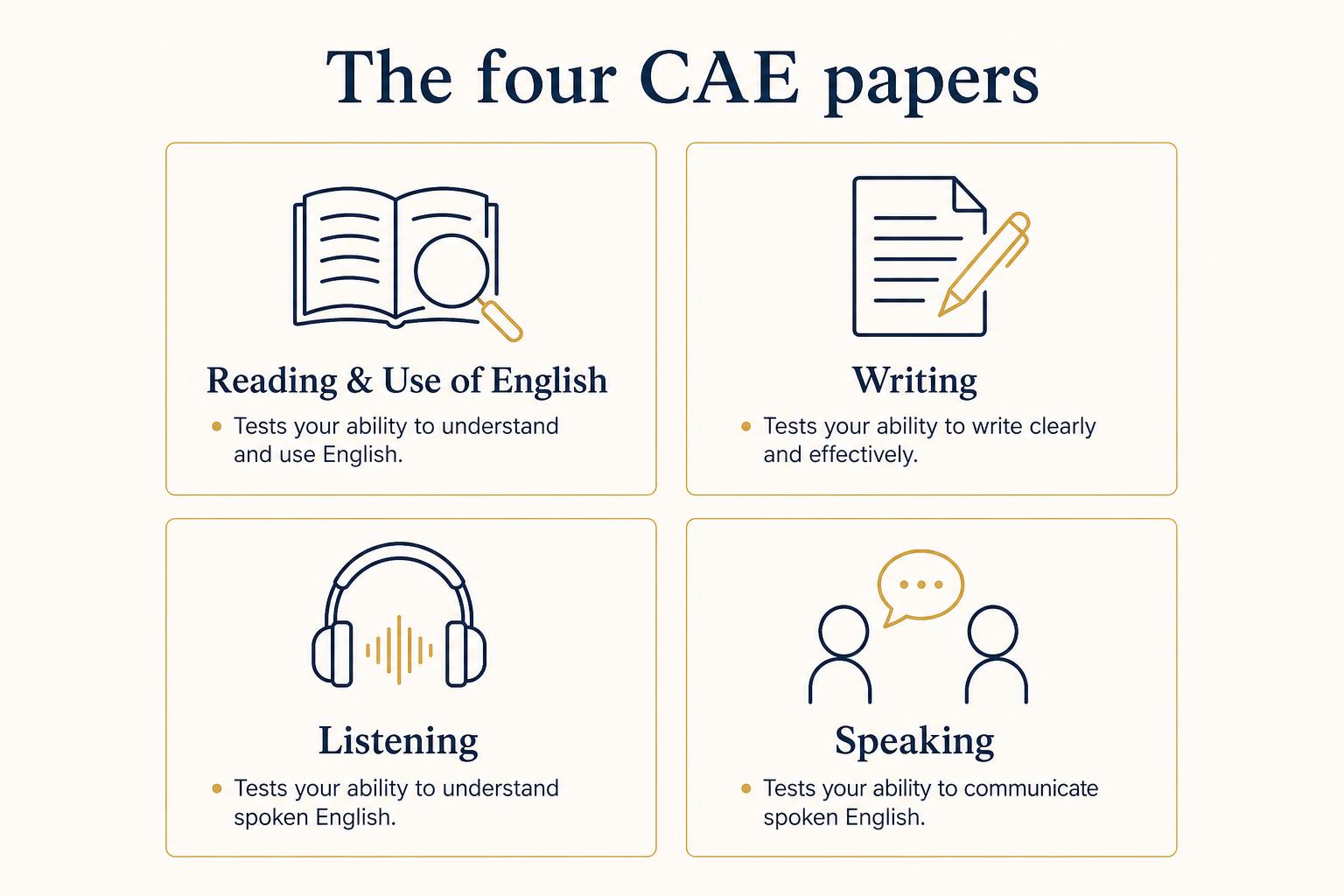
Discuss in pairs
Which paper looks most familiar to you, and which feels most unknown? Why?
R&UoE Part 1 — Multiple Choice Cloze
Strategy
- 1.Read the whole text once for gist before touching any gap.
- 2.Predict the kind of word the gap wants — before looking at the options.
- 3.Test each option in the full sentence; listen for the collocation.
- 4.If stuck, eliminate the two clearly weakest options first.
Example
'She made a ___ contribution.' A) heavy B) significant C) wide D) full. Answer: B — 'significant contribution' is a fixed collocation.
Practice · Section 9
7 minFill in the blank
Question 1.His comments had a ___ effect on the rest of the meeting.
Question 2.The two candidates are ___ different in their approach.
Question 3.I ___ to be quite methodical when I'm under pressure.
Question 4.More often than ___ , my best ideas come on a walk.
Question 5.She came ___ as quite reserved at first.
Question 6.It's been a steep learning ___ , but I'm getting there.
Q1.Complete with one word: 'I'm ___ two minds about applying this year.'
Q2.Complete with one word: 'Broadly ___ , I enjoy working in teams.'
Writing · Section 10
4 minPut it in writing
Your task
Write a 100-word personal statement introducing yourself to your CAE classmates.
- • Who you are (one sentence).
- • Why CAE, right now (one sentence).
- • One strength + one area to develop.
- • Use at least 3 hedging expressions from today.
Before you submit
- ☐ I used at least 3 hedges (I'd say / broadly / tend to…).
- ☐ I included one C1 vocabulary item from today.
- ☐ I avoided flat 'I am / I like' statements.
- ☐ My word count is 95–110.
Show model answer
I'm Maria, originally from Barcelona, and I've been working as a junior project manager for the last two years. I'd say I'm taking CAE for a mix of professional and personal reasons — broadly speaking, my company values it for promotions, but I also want a clearer way of speaking about complex ideas in English. On the whole, I think my biggest strength is that I tend to stay fairly level-headed under pressure. What I want to develop is range: more precise vocabulary, less repetition, and more confidence hedging an opinion instead of just stating one.
Make it a real conversation
Pairs. 3 minutes each as examiner / candidate. The examiner asks 3 questions; the candidate answers using at least 2 hedges and 1 C1 item from today. Listener counts hedges and feeds back at the end.
Speaking Part 3 mini-board — decide together, then justify to the class.
Which CAE paper should you prepare FIRST — and why?
Reading & Use of English
Biggest paper, most marks at stake.
Writing
Slow gains, but transferable to all papers.
Listening
Hardest to fake — needs daily training.
Speaking
Highest fear factor; quickest visible progress.
Useful phrases
- I'd say I'm broadly…
- I tend to… , particularly when…
- More often than not, I…
- On the whole, I find that…
- It depends, really — if X, then…
- I wouldn't say I'm X exactly, but…
- These days, I'm trying to…
- I'm in two minds about that.
- ExaminerHow would you describe yourself as a learner?
- You_______________
- ExaminerIs there anything you'd like to change about the way you study?
- You_______________
Optional · Teacher-led
Teacher Activities
Two optional extensions for a longer (75–90 min) session, or to slot in as fast-finisher work. ~18 min total
Homework · Section 12
Take-homeTake it home
Expand today's 100-word personal statement into a 220-word version. Add one specific anecdote that shows — rather than tells — one of your strengths.
prompts · Use these as guiding questions
- What specific moment proves your strength? (Place, people, what you did.)
- What did you do that someone else might not have done?
- What did the outcome tell you about yourself?
vocab list · Recycle at least 5 of these from today
- I'd say / broadly speaking / more often than not
- tend to / come across as / level-headed
- find your feet / a steep learning curve / in two minds about
Record a 90-second voice note answering the question below. Use at least three hedges.
questions · Your question
- What's something you've changed your mind about in the last year — and what changed it?
prompts · Self-listening checklist
- Did I use at least 3 hedges (I'd say / tend to / broadly…)?
- Did I sound like myself, or like a candidate?
- Did I shift tense at least once (present → present perfect)?
Match each C1 expression below to a personal example sentence about yourself.
vocab list · Eight C1 expressions
- broadly speaking
- tend to
- more often than not
- come across as
- level-headed
- find your feet
- a steep learning curve
- in two minds about
prompts · Instructions
- Write 8 sentences — one per expression.
- Each sentence must be true about you.
- Bring them to the next lesson; you'll read three aloud to a partner.
Recap · Section 13
Wrap-upWhat you've learned
- CAE rewards range, accuracy and stance — not memorised phrases or maximum length.
- Hedging language is core C1, not optional polish.
- R&UoE Part 1 turns on collocation and shade of meaning — predict before you look.
- Word stress in multi-syllable words has an outsized effect on perceived fluency.
- Your CAE goal: not 'pass the exam' but 'sound more like the person you want to be in English'.
Need more practice?
Extra Practice for the task types and language in this lesson. Optional — it never changes your progress.
Lesson complete
Mark this lesson done to save your progress.