
Module 2 · Grammar in Action · Lesson 05
Key Word Transformations
Patterns, paraphrase and precision
Get talking · Section 1
4 minGet talking
In pairs: 'They made me wait an hour.' Rewrite it FIVE ways without changing the meaning. How many can you do in 60 seconds?
Which two are closest? a) 'I regret not calling her.' b) 'I wish I had called her.' c) 'If only I called her.' d) 'I should have called her.' Justify your pick.
What grammar does each word usually 'trigger'? SUGGESTED → ? UNLESS → ? HAD → ? WISHES → ? LIKELY → ?
The 12 transformation patterns (and how to spot them)
Quick rule
Don't translate — RECOGNISE the pattern. The given keyword is a signpost: it tells you which grammar family you're in.
CAE Part 4 isn't 60 unrelated puzzles — it's a closed set of roughly a dozen recurring grammar 'families' tested in rotation: reporting verbs (suggest/admit/deny + -ing or that-clause), reported speech (tense backshift), causative have/get something done, modals of past deduction (must/might/can't have + done), wish / if only / regret, comparatives (not as… as / the more… the more), conditionals (mixed, unless, provided that), passives (especially 'is said to have…'), participle clauses, cleft / inversion ('not only… but also', 'no sooner… than'), gerund vs infinitive, and dependent prepositions / fixed phrases. Identify the family first, fit the words second, then verify: same meaning? keyword unchanged? 3–6 words? Train the routine, not just the items.
Examples
Reporting: 'You should rest,' Tom said to me. → Tom ADVISED me TO REST. (advise sb to do)
Causative: Someone has stolen my bike. → I HAVE HAD MY BIKE STOLEN. (have something done)
Modal of deduction: It's possible she missed the train. → She MIGHT HAVE MISSED the train.
Wish: I regret not studying harder. → I WISH I HAD STUDIED harder. (wish + past perfect = past regret)
Comparative: I've never read a better book. → This is THE BEST BOOK I'VE ever read.
Cleft / inversion: As soon as we arrived, it rained. → NO SOONER HAD WE arrived than it rained.
Quick check
Question 1.Best transformation: 'They cleaned my suit yesterday.' Keyword: HAD
Question 2.'It is said that he stole the money.' Keyword: HAVE
Question 3.'I'm sure she didn't see us — she didn't wave.' Keyword: CAN'T
Question 4.'"Don't touch the wires," the engineer told us.' Keyword: WARNED
Question 5.Which answer BREAKS the rules?
Build the sentence → spot the natural chunks → say it aloud → reply like a real conversation.
1.Build a causative answer for 'Someone has stolen my bike.' (keyword: HAD)
2.Build a 'wish' past-regret answer. (keyword: WISHES)
3.Build a reporting answer for '"Why don't we go for a walk?"' (keyword: SUGGESTED)
Quick check 1.How many words (inclusive) must your answer contain in CAE Part 4?
Quick check 2.True or false: you may change the form of the given keyword if it sounds better.
Words & phrases to own
have / get something done
causative — arrange for someone else to do something
Use it now
Say one sentence that is true about you using this expression.
be said / thought / believed to have done
impersonal passive reporting structure
Use it now
Say one sentence that is true about you using this expression.
no sooner… than / hardly… when
inversion meaning 'immediately after'
Use it now
Say one sentence that is true about you using this expression.
provided / providing that
conditional connector = 'only if'
Use it now
Say one sentence that is true about you using this expression.
unless
= 'if not'; triggers a positive verb after it
Use it now
Say one sentence that is true about you using this expression.
would rather (someone) did
preference about another person — past form, present meaning
Use it now
Say one sentence that is true about you using this expression.
it's (high) time (someone) did
criticism that something hasn't happened yet — past form, present meaning
Use it now
Say one sentence that is true about you using this expression.
regret + -ing / wish + past perfect
two ways to express past regret
Use it now
Say one sentence that is true about you using this expression.
Tap an item on the left, then tap its match on the right.
Pronunciation · Section 4
3 minStress signals paraphrase
When you say a transformed sentence aloud, the new keyword often takes contrastive stress because it's the bit that has shifted meaning. Training students to STRESS the keyword as they read each answer helps them feel whether the paraphrase still matches the original. If the stress feels wrong, the answer usually is.
- Original: 'I'm SURE she didn't see us.' → Paraphrase: 'She CAN'T have SEEN us.' (stress on CAN'T + SEEN)
- Original: 'They CLEANED my suit.' → Paraphrase: 'I HAD my suit CLEANED.' (stress on HAD + CLEANED)
- Original: 'It's POSSIBLE she missed the train.' → 'She MIGHT have MISSED the train.' (stress on MIGHT + MISSED)
- Original: 'I REGRET not calling.' → 'I WISH I had CALLED.' (stress on WISH + CALLED)
- Original: 'AS SOON AS we arrived, it rained.' → 'NO SOONER had we ARRIVED than it rained.' (stress on NO SOONER + ARRIVED)
Reading · Section 5
8 minThe End of the Career Ladder: A New Paradigm of Work
The traditional concept of the ‘career ladder’ is undergoing a seismic shift, one that has left both sociologists and corporate leaders scrambling for answers. For decades, the implicit agreement between employer and employee was predicated on a clear, if somewhat rigid, trajectory: loyalty and diligence were rewarded with incremental promotions and a predictable retirement. However, in the wake of recent global disruptions, this socio-economic contract is believed to have been irrevocably altered. It is no longer a matter of simply puttering along until retirement; today’s workforce is increasingly preoccupied with the search for meaning, autonomy, and a genuine work-life balance.
One of the primary drivers of this change is the realisation that the traditional model may not be as sustainable as once thought. Many professionals find themselves trapped in a cycle of diminishing returns, where the promise of future security is perpetually overshadowed by the demands of the present. Indeed, it’s high time that we addressed the psychological toll of a culture that prioritises 'presenteeism' over actual output. Providing that an individual meets their targets, does it truly matter where or when the work is actually performed? For a growing number of workers, the answer is a resounding 'no'. They would rather accept a slightly lower salary in exchange for the freedom to manage their own schedules, a trade-off that was once considered unthinkable in many professional circles.
The shift is particularly evident in the way people now view their relationship with the physical office. For many, the daily commute is increasingly seen as an avoidable drain on both time and mental energy. No sooner had the necessity of remote work been demonstrated than the arguments against it began to look increasingly hollow. While some managers remain tethered to the idea of 'performative presence', suggesting that junior staff can only learn through osmosis in a shared space, the data tells a different story. Productivity levels have remained stable, if not increased, during the pivot to hybrid models. Unless companies can provide a compelling reason for a return to the office, they risk alienating their most talented employees.
Moreover, the rise of the 'portfolio career' suggests a move away from the cradle-to-grave employment model. Professionals are now more likely to have their services outsourced to multiple clients, reclaiming a sense of agency that is often lost in a traditional corporate hierarchy. They get their specialized tasks done on their own terms, often at a higher premium. While this lack of security might once have been viewed with trepidation, it is now often framed as a liberating alternative to the 'golden handcuffs' of corporate life. Many regret having stayed in unsatisfying roles for as long as they did, wishing they had taken the leap into self-employment years earlier.
This is not to say that the traditional office is dead, but rather that its function is being redefined. It is becoming a hub for collaboration and connection, rather than a place of daily penance. However, the onus is on employers to adapt to this new reality. Those who remain loath to embrace flexibility may find themselves facing a talent drain of unprecedented proportions. The era of the one-size-fits-all career is over; in its place, a more nuanced, individualized approach to work is emerging, provided that both managers and employees are willing to navigate this transition with an open mind.
Question 1.In the first paragraph, the writer’s main point is...
Question 2.What does the writer suggest about the 'socio-economic contract' in the second paragraph?
Question 3.What is the writer's attitude toward the 'burnout' mentioned in the third paragraph?
Question 4.What does the phrase 'performative presence' imply in the context of the fourth paragraph?
Question 5.The writer concludes that the current shift in work habits is...
Question 6.What does the word 'loath' mean in the final paragraph?
Q1.The writer suggests that traditional career paths were always viewed as psychologically damaging.
Q2.The text implies that ‘performative presence’ is often used by management to justify a return to the office.
Q3.According to the passage, many employees are now willing to sacrifice financial gain for personal autonomy.
Q4.The writer believes that the decline of the traditional office is a purely negative development for company culture.
Listening · Section 6
8 minThe Great Recalibration: A Discussion on the Modern Workplace
Listening audio
Tap play to listen. Replay as many times as you need.
Show transcript
Priya (RP, f):Welcome back. Today we’re discussing the ‘Great Resignation’ and its aftermath. With me are Niamh, a recruitment consultant, and Hamish, who recently overhauled his entire career path.
Niamh, is it fair to say the power dynamic has shifted entirely toward the employee?
Niamh (Irish, f):Well, it’s certainly been painted that way in the press, hasn't it? But I’d say that’s a bit of an oversimplification. While it’s true that candidates are more discerning, it isn't quite the free-for-all some suggest.
No sooner had the first wave of resignations hit than companies began tightening their belts in response to inflation. It’s a nuanced picture.
Hamish (Scottish, m):I have to chime in there, Niamh. From my perspective, it wasn't just about the money or the market. It was about autonomy.
I’d rather my employer trusted me to manage my own output than monitored my clock-in times. When my old firm refused to budge on remote work, I felt it was high time I took the plunge into freelancing. It wasn't a snap decision; it was a long-overdue correction.
Priya (RP, f):And Hamish, do you think your experience is representative? Many would say they’d love to leave but feel tethered by financial commitments.
Hamish (Scottish, m):Oh, absolutely. I’m not suggesting everyone should just walk out tomorrow. Providing that you have a solid three-month buffer in the bank, it’s viable.
Without that safety net? Well, unless you’re in a high-demand niche like tech, it’s a massive gamble. I do regret not starting my transition sooner, though.
I spent years in a role that, frankly, was soul-destroying.
Priya (RP, f):That’s an interesting point. Niamh, we’re seeing more people like Hamish opting for the 'portfolio career'. How are firms adapting?
The old-school structures seem to be crumbling.
Niamh (Irish, f):They are, albeit slowly. Interestingly, many of my corporate clients are actually relieved to have some functions outsourced to experts like Hamish. It’s often more cost-effective for them to get specialized tasks done by freelancers than to provide a full benefits package for a permanent staff member who might leave anyway.
It’s a symbiotic shift, even if it feels chaotic right now.
Priya (RP, f):But doesn't that lead to a lack of company culture? If everyone is a 'hired gun', where’s the loyalty?
Niamh (Irish, f):Culture has to evolve. It’s believed to have been rooted in the physical office for too long. If a company's identity is so fragile it can't survive a distributed workforce, then perhaps it wasn't that strong to begin with.
We need to stop equating presence with productivity.
Hamish (Scottish, m):I agree. Though I must admit, I do miss the occasional water-cooler chat. Freelancing can be a solitary pursuit, and I’ve had to be far more disciplined with my schedule than I ever was in the office.
Still, I wouldn't trade the flexibility for anything.
Priya (RP, f):So, the consensus is: it's not a rebellion, but a recalibration?
Niamh (Irish, f):Spot on. It’s about finding a middle ground where both parties feel they’re getting a fair deal, rather than the one-sided arrangements of the past.
Question 1.What is Niamh’s view on the current power dynamic in the labour market?
Question 2.How does Hamish describe his decision to leave his previous job?
Question 3.What point does Hamish make about the feasibility of resigning?
Question 4.What is Niamh’s observation regarding her corporate clients?
Question 5.What does Niamh imply about company culture?
Question 6.In the final exchange, how do the speakers characterize the 'Great Resignation'?
Question 1.The tutor's overall message about Part 4 is best summarised as…
Visual stimulus · Section 7
3 minA real Part 4 page
30 seconds of silent scanning. Before you write anything, decide for EACH item: which grammar family is this?
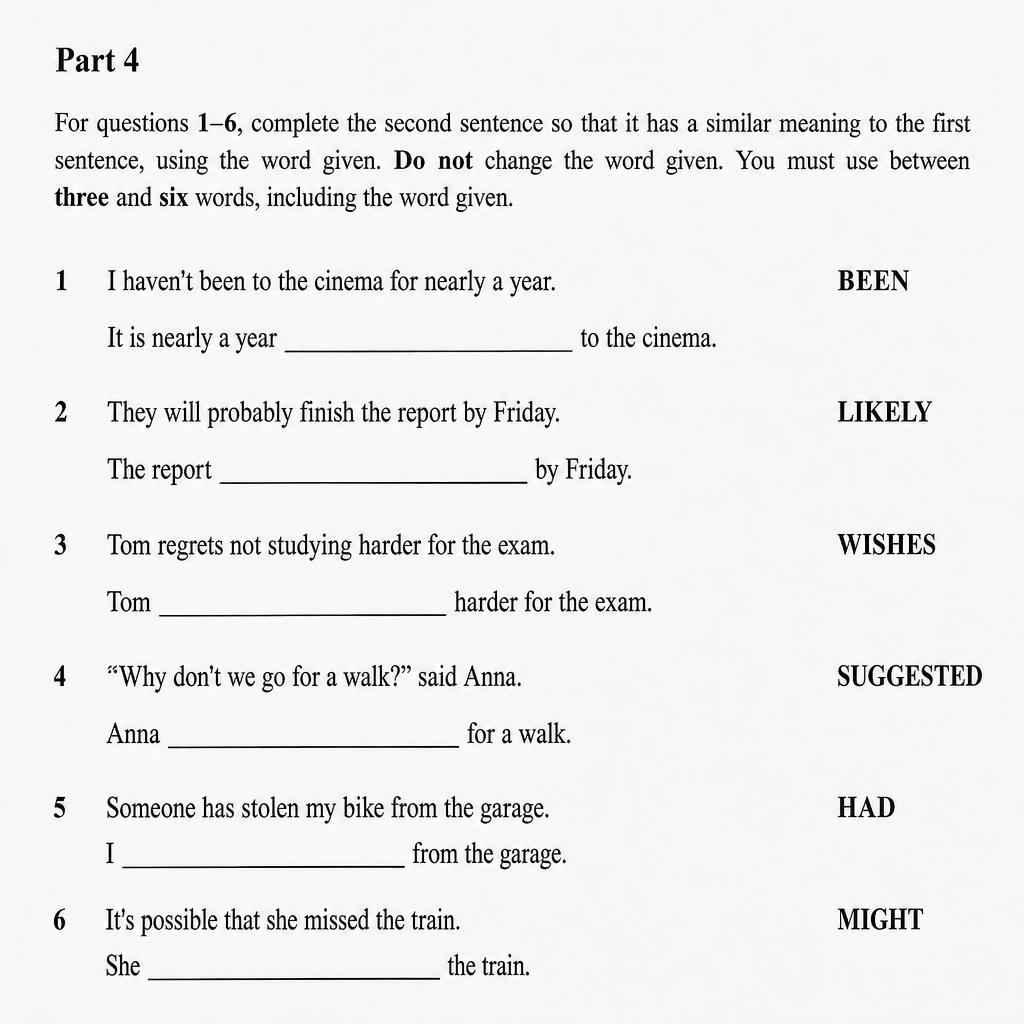
Discuss in pairs
In pairs, label each of the 6 items with a family: causative / reporting / wish / modal of deduction / impersonal passive / inversion. Then attempt the gaps.
R&UoE Part 4 — Key Word Transformations, in depth
Strategy
- 1.Read BOTH sentences first; underline the meaning that must survive.
- 2.Name the GRAMMAR FAMILY out loud: causative / reporting / wish / modal of deduction / passive / inversion.
- 3.Draft your answer; count the words on your fingers (3–6 INCLUDING the keyword).
- 4.Verify: same meaning? keyword UNCHANGED in form? grammar of the second sentence intact?
- 5.If two halves are possible, aim for the half you're most sure of — partial marks exist.
Example
'They will probably finish the report by Friday.' Keyword: LIKELY. Family = 'be likely to' + passive (because we don't keep 'they'). Draft: 'is likely to be finished'. Count: 5 words including LIKELY. Meaning: same. Keyword form: unchanged. Commit.
Practice · Section 9
7 minFill in the blank
Question 1.She wishes she ___ harder for the exam last year.
Question 2.I ___ my hair cut yesterday — it was getting too long.
Question 3.She is said ___ the painting from the gallery years ago.
Question 4.He ___ have missed the train — his car broke down on the way.
Question 5.No sooner ___ we sat down than the waiter brought the menu.
Question 6.Anna suggested ___ for a walk before dinner.
Question 7.Provided ___ on time, we'll catch the early train.
Question 8.It's high time you ___ a decision about the job offer.
Q1.Transform: 'They cleaned my car yesterday.' Keyword: HAD. Fill the gap (3–6 words including HAD): 'I ____________ yesterday.'
Q2.Transform: 'It's possible that she forgot.' Keyword: MIGHT. Fill the gap: 'She ____________.'
Q3.Transform: 'I regret not booking the flight.' Keyword: WISH. Fill the gap: 'I ____________ the flight.'
Q4.Transform: '"Don't open the door," she said.' Keyword: WARNED. Fill the gap: 'She ____________ the door.'
Writing · Section 10
4 minPut it in writing
Your task
Take any FIVE sentences from a recent email or message you wrote (English or translated). Rewrite each one TWICE: once using a reporting verb, once using a passive or causative. Aim for genuine paraphrase, not synonym swapping.
- • Show TWO transformations per original (10 sentences total).
- • Label each transformation with the family (reporting / passive / causative).
- • Don't change meaning. Don't pad with extra words.
Before you submit
- ☐ 10 transformations, all labelled.
- ☐ Each pair preserves the original meaning.
- ☐ At least one causative ('have something done') used.
- ☐ At least one impersonal passive ('is said to have…') used.
Show model answer
Original 1: 'I'll send the report by Friday.' Reporting: 'She PROMISED to send the report by Friday.' Passive: 'The report WILL BE SENT by Friday.' Original 2: 'Someone has fixed our heating.' Causative: 'We've HAD our heating FIXED.' Passive: 'Our heating HAS BEEN FIXED.' Original 3: 'It's possible he missed the email.' Modal: 'He MIGHT HAVE MISSED the email.' Reporting: 'She SUSPECTED that he had missed the email.'
Make it a real conversation
Say-it-again pairs. In pairs, take turns: Student A reads one of the prompts aloud. Student B must rephrase it within 10 seconds using the keyword in brackets. Swap roles each round. Time: 6 minutes.
Useful phrases
- So you mean… (paraphrase)
- In other words…
- What you're saying is essentially…
- Another way of putting it…
- I'd rephrase that as…
- It might also be said that…
- To put it differently…
- That's the same as saying…
- A'Someone cleaned my office while I was on holiday.' (HAD)
- B_______________
- A'I'm sure she didn't see the email.' (CAN'T)
- B_______________
- A'"Why don't we postpone the meeting?" said Tom.' (SUGGESTED)
- B_______________
Optional · Teacher-led
Teacher Activities
Two extensions for stronger groups or longer sessions. ~22 min total
Homework · Section 12
Take-homeTake it home
Complete EIGHT mixed key-word transformations. For each one, name the grammar family in brackets before writing the answer.
questions · Eight items (write the gap only, 3–6 words including the keyword)
- 1. They will deliver the parcel tomorrow morning. (DELIVERED) — The parcel ____________ tomorrow morning.
- 2. I'm sure he didn't lock the door. (CAN'T) — He ____________ the door.
- 3. 'Don't swim here,' the lifeguard said. (WARNED) — The lifeguard ____________ there.
- 4. Someone has repaired my watch. (HAD) — I ____________.
- 5. People believe she invented the device. (HAVE) — She is believed ____________ the device.
- 6. I regret telling him the secret. (WISH) — I ____________ him the secret.
- 7. As soon as the film started, the lights went out. (SOONER) — No ____________ than the lights went out.
- 8. It's possible we took the wrong turning. (MIGHT) — We ____________ the wrong turning.
Build a one-page 'KWT family map'. For each of the SIX families, write the trigger keywords you'd expect to see and ONE model transformation.
vocab list · Six families to cover
- Causative (have/get something done)
- Modal of past deduction (must/might/can't have + p.p.)
- Reporting verbs (suggest/admit/advise/warn…)
- Wish / If only / It's high time
- Impersonal passive (is said/believed/thought to have…)
- Inversion after negative adverbials (no sooner, hardly, not only, never)
prompts · For each family
- List 3 trigger keywords that usually signal it.
- Write ONE model transformation you can recall from memory.
- Mark the family you find HARDEST — that's tomorrow's first drill.
Write a 100–120 word study journal entry: 'The transformation family I find easiest, and the one I find hardest — and why.' Use at least THREE technical labels from this lesson (e.g. causative, impersonal passive, inversion).
prompts · Include
- One named family you find easy + the trigger keyword that makes it easy for you.
- One named family you find hard + the exact error you keep making.
- One concrete plan for next week's revision.
Record yourself (60–90 seconds) explaining ONE transformation family to an imaginary classmate as if you were the teacher. Name the family, give the trigger keywords, model one example aloud, and warn about the most common mistake.
prompts · Cover, in this order
- Name the family.
- Give 2–3 trigger keywords.
- Say one full model transformation aloud.
- Warn about the most common error (e.g. changing the keyword).
Recap · Section 13
Wrap-upWhat you've learned
- Part 4 = six items, 1 mark per half (max 12), 3–6 words INCLUDING the keyword, keyword UNCHANGED.
- It's a closed set of grammar families — name the family before you write the words.
- Routine: read both → name family → draft → count words → verify meaning + keyword form.
- Most common errors are routine errors (keyword changed, word count wrong), not knowledge errors.
- Train paraphrase as a real-world editing skill, not as exam trivia.
Need more practice?
Extra Practice for the task types and language in this lesson. Optional — it never changes your progress.
Lesson complete
Mark this lesson done to save your progress.