
Module 1 · Foundations of CAE · Lesson 04
Listening Part 1 Decoded
Short extracts: gist, attitude, feeling
Get talking · Section 1
4 minGet talking
Read aloud — three times, three meanings: 'Oh, that's interesting.' (genuine / sarcastic / polite-but-bored). What changes? Words? Tone? Both?
Which speaker is more committed? A: 'It's a disaster.' B: 'It's not exactly been a triumph, has it?' What does B's hedge tell you about how they feel?
In 60 seconds, list every word/phrase you know to describe how someone FEELS about something: e.g. enthusiastic, sceptical, lukewarm, in two minds…
Hedges, intensifiers and modals of attitude
Quick rule
Attitude is rarely stated — it's hedged, intensified or buried in a modal. 'I suppose it's fine' ≠ 'It's absolutely fine.'
In real speech — and in Listening Part 1 — speakers rarely announce their attitude bluntly. They signal it through hedges ('I suppose', 'sort of', 'not exactly'), intensifiers ('absolutely', 'thoroughly', 'genuinely') and modals that colour an opinion ('I would say', 'it might be that', 'you'd have thought…'). To answer attitude questions, you have to read those signals as carefully as you read the noun and verb. A 'yes' wrapped in 'I suppose' is rarely a yes.
Examples
I'd say it's been more rewarding than I expected — though I'm not getting carried away.
It's not exactly the breakthrough we were hoping for, is it?
You'd have thought a project this size would be straightforward — turns out, not so much.
I'm genuinely enthusiastic, but I do have one or two reservations.
I suppose it's fine — it's just not what I had in mind.
Quick check
Question 1.'I suppose it's fine.' — what attitude does the speaker most likely signal?
Question 2.'You'd have thought a project this size would be straightforward.' — the speaker probably means…
Question 3.Which sentence is the LEAST committed?
Question 4.'I'm genuinely enthusiastic, but I do have one or two reservations.' — the overall attitude is…
Build the sentence → spot the natural chunks → say it aloud → reply like a real conversation.
1.Build a hedged-positive opinion.
2.Build an attitude sentence using 'not exactly'.
Quick check 1.True or false: in Listening Part 1, the correct answer is usually a near-paraphrase of what the speaker says, not the exact wording.
Words & phrases to own
enthusiastic about
openly positive and energetic about something
Use it now
Say one sentence that is true about you using this expression.
lukewarm about
showing little enthusiasm; not really for or against
Use it now
Say one sentence that is true about you using this expression.
in two minds about
unable to decide; genuinely undecided
Use it now
Say one sentence that is true about you using this expression.
broadly in favour of
generally supportive, with some reservations
Use it now
Say one sentence that is true about you using this expression.
sceptical about / of
doubtful; not convinced something is true or will work
Use it now
Say one sentence that is true about you using this expression.
have reservations about
to feel partly unsure; to disagree on some points
Use it now
Say one sentence that is true about you using this expression.
be taken aback by
to be surprised — often unpleasantly — by something
Use it now
Say one sentence that is true about you using this expression.
be quietly confident
to feel sure something will succeed, without showing off
Use it now
Say one sentence that is true about you using this expression.
Tap an item on the left, then tap its match on the right.
Pronunciation · Section 4
3 minIntonation = attitude
At C1, intonation is the single biggest carrier of attitude. A rising tail on 'I suppose so↗' signals doubt; a falling 'I suppose so↘' sounds resigned; a flat 'I suppose so.' sounds bored. Drill the same words with different intonation contours until students can hear — not just read — the attitude.
- 'It's been INteresting.' — genuine vs. polite-but-bored: shift the stress from INteresting to interESTing and notice the change.
- 'I'm broadly in FAvour…' (slight rising tail → 'but is coming').
- 'You'd have THOUGHT it would be straightforward.' (high pitch on THOUGHT signals 'and it wasn't').
- 'I'm QUIETly CONfident.' (low, even pitch — calm certainty, not excitement).
- 'I was QUITE taken aBACK.' (jump in pitch on aBACK = real surprise).
Reading · Section 5
8 minBeyond the Bottom Line: The Rise of the Well-being Economy
The traditional metrics of national success, primarily the Gross Domestic Product (GDP), have long been the holy grail for policymakers. However, a growing cohort of progressive economists is becoming increasingly sceptical of this obsession with raw output. They argue that while the balance sheet might look healthy, the lived experience of the citizenry often tells a far more nuanced, and sometimes darker, story. In recent years, the concept of a 'well-being economy' has gained traction, seeking to prioritise human and ecological health over the relentless pursuit of growth. Yet, as with many paradigm shifts, the rhetoric often outpaces the reality.
Politicians, ever keen to appear modern, have been quick to adopt the lexicon of well-being. It is now common to hear leaders speak of 'thriving communities' and 'holistic growth,' yet many analysts have reservations about whether these phrases are anything more than sophisticated hedges. By using such expansive, positive language, those in power can effectively deflect criticism of systemic failures in healthcare or housing. If a government can claim its citizens are 'broadly in favour' of its general direction based on a cherry-picked happiness index, it can bypass the more uncomfortable data regarding rising inequality or crumbling infrastructure.
Furthermore, many social scientists appear in two minds about the validity of self-reported well-being data. While it is certainly better than ignoring the human element entirely, the methodology is often fraught with cultural bias and the 'hedonic treadmill' effect. For instance, a population might report being 'quietly confident' about the future simply because they have lowered their expectations to meet a grim reality, rather than because conditions have actually improved. This psychological adaptation makes it difficult to draw definitive conclusions from survey results. One might be taken aback by high happiness scores in regions with minimal social safety nets, only to find that these scores reflect a survivalist stoicism rather than genuine flourishing.
The shift toward attitudinal data also brings into question the role of intensifiers and modals in public discourse. When a report states that a policy 'should' lead to 'significant' improvements in life satisfaction, the underlying uncertainty is often buried beneath the weight of the adjective. This linguistic sleight of hand allows for a degree of plausible deniability; if the touted benefits fail to materialise, the 'should' provides an easy exit. It is this lack of accountability that makes the public so lukewarm about new government initiatives, regardless of how enthusiastically they are presented in the media.
Ultimately, while the move away from a purely GDP-focused world is a step in the right direction, we must remain vigilant. The vocabulary of feeling and attitude can be just as easily manipulated as the hard data of economics. Until we see a more rigorous, transparent approach to measuring what truly matters, many will remain understandably sceptical of the well-being revolution. A truly successful society is not one that merely claims to be happy in its annual reports, but one where the structural foundations for that happiness are robust and undeniable. Without that, the 'well-being economy' risks becoming just another hollow catchphrase in the annals of political spin.
Question 1.What is the author's view of 'progressive economists' in the first paragraph?
Question 2.What does the author imply about the use of the word 'thriving' by politicians?
Question 3.In the third paragraph, the author's tone suggests they are...
Question 4.What does the author identify as a major flaw in current 'well-being' assessments?
Question 5.What is the author's conclusion regarding the 'well-being economy'?
Question 6.Why does the author use the phrase 'the statistics may suggest one thing, but the gut says another'?
Q1.The author believes that GDP is a more reliable measure of success than well-being indices.
Q2.The author suggests that language used by politicians can be intentionally vague to avoid responsibility.
Q3.The author argues that high happiness scores do not always indicate a high standard of living.
Q4.The author is enthusiastic about the current implementation of 'well-being' policies.
Listening · Section 6
8 minThe Infrastructure Dilemma
Listening audio
Tap play to listen. Replay as many times as you need.
Show transcript
Rhys (Welsh, m):Today we're joined by Isla and Fraser to discuss the proposed high-speed rail link. Isla, you’ve been following the public consultations closely. What’s the general vibe?
Isla (Scottish, f):Well, Rhys, to be honest, I was initially quite taken aback by the sheer scale of the opposition. I’d expected some local grumbling, but the pushback from environmental groups has been fierce. Personally, I’m in two minds about it.
On one hand, the connectivity is vital, but the destruction of ancient woodland seems an incredibly high price to pay.
Fraser (Scottish, m):I take your point, Isla, but shouldn't we look at the bigger picture? I’m broadly in favour of the project because the long-term carbon savings from reduced flights are undeniable. I wouldn't go as far as to say I'm thrilled, but I'm quietly confident that the ecological mitigation strategies will actually work.
Rhys (Welsh, m):"Quietly confident"? That seems a bit of a stretch, Fraser. The track record for these "mitigation" schemes is patchy at best.
I find myself increasingly sceptical of the official projections. They always seem to lowball the costs and overestimate the benefits.
Isla (Scottish, f):I suppose you could argue that, Rhys, but if we don't modernise, our infrastructure will just crumble. While I have reservations about the management of the budget—which is, let’s face it, spiralling—the core objective remains sound. I’m not exactly enthusiastic about the current timeline, though.
It’s been pushed back twice already.
Fraser (Scottish, m):Exactly. And whenever the government uses that legalistic, hedged language like "subject to further review," you know another delay is coming. I must admit, I was somewhat lukewarm about the whole thing initially, but now I’m starting to think it might be a white elephant.
Rhys (Welsh, m):Wait, Fraser—you just said you were broadly in favour! Are you backtracking?
Fraser (Scottish, m):Not backtracking, just... refining my position. I support the concept, but the execution?
That's where I start to lose faith. It's the gap between the vision and the reality that's the problem.
Isla (Scottish, f):And that's precisely why the public is so disillusioned. People feel that their concerns are being met with these polished, hollow intensifiers—"vital importance," "absolute necessity"—while the actual evidence of benefit remains thin. I think we should be more demanding of the planners.
Rhys (Welsh, m):So, are we saying the project is doomed, or just poorly handled?
Isla (Scottish, f):Poorly handled, definitely. I’d still like to see it happen, but only if they can prove they’ve actually listened to the environmentalists, rather than just nodding politely and moving the bulldozers in anyway.
Fraser (Scottish, m):I’d agree with that. It needs a total overhaul of its communication strategy, at the very least. At the moment, it's a PR disaster.
Question 1.What is Isla’s attitude towards the rail project in her first turn?
Question 2.How does Rhys feel about 'ecological mitigation'?
Question 3.What does Fraser imply when he mentions the phrase "subject to further review"?
Question 4.What is Isla's opinion on the language used by project planners?
Question 5.In his second-to-last turn, Fraser seems to...
Question 6.The speakers end the discussion with...
Question 1.Maya says: 'I'm not complaining — readers care, and that's a gift. But I won't pretend it hasn't made me think differently about what I'd publish next.' Her overall attitude is best described as…
Visual stimulus · Section 7
3 minA real Listening Part 1 page
30 seconds of silent scanning — this is what you'll see on the day, BEFORE you hear anything.
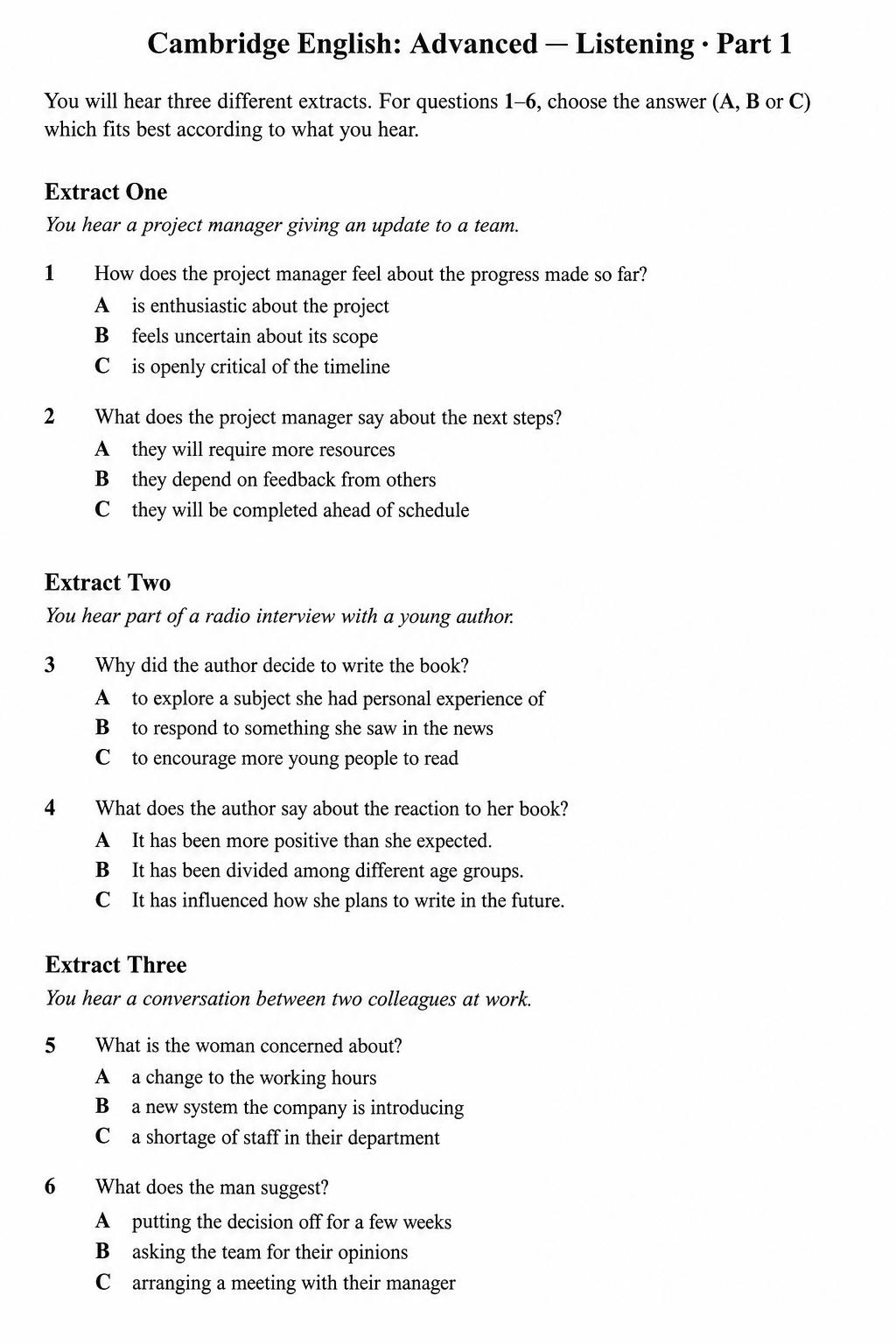
Discuss in pairs
In pairs, predict for each question: what kind of attitude word would the correct option contain? Then check against the listening.
Listening Part 1 — three short extracts, in depth
Strategy
- 1.Use the pause to read BOTH question stems for the next extract.
- 2.Predict the kind of attitude word the answer will contain (positive? hedged? critical?).
- 3.On first listen — answer in pencil. On second listen — confirm by finding the EXACT hedge / qualifier.
- 4.Beware the decoy: the loudest adjective is often a trap.
- 5.If two options look similar, choose the one whose feeling matches the speaker's hedges.
Example
Q: 'How does the project manager feel about the progress?' Speaker: 'On paper, we're roughly where we said we'd be… that said, I'd be lying if I told you I'm completely relaxed about the timeline.' The hedge 'I'd be lying if I told you I'm completely relaxed' = worried. Answer: broadly satisfied but worried about the next phase.
Practice · Section 9
7 minFill in the blank
Question 1.She's ___ enthusiastic about the new role, but she does have one or two reservations.
Question 2.I'm ___ in two minds about it, to be honest — I can see both sides.
Question 3.He was ___ taken aback by the size of the response to his article.
Question 4.I'm ___ in favour of the proposal, but I'd like to see the figures first.
Question 5.She remained ___ confident throughout, even when results were slow to come in.
Question 6.Frankly, I'm rather ___ about whether this approach will work in practice.
Question 7.The reception has been ___ — some readers loved it, others were uneasy.
Question 8.I wouldn't say I'm disappointed — more, well, a bit ___ on the whole idea.
Q1.Listening paraphrase. Speaker says: 'I'd be lying if I told you I'm completely relaxed about the timeline.' Choose ONE word that describes the speaker's attitude.
Q2.Listening paraphrase. Speaker says: 'I'm just sceptical we're ready for it.' This means the speaker has serious ___.
Q3.Open Cloze (one word): 'She was taken ___ by the strength of the reaction to her book.'
Writing · Section 10
4 minPut it in writing
Your task
Write a 90–110 word internal note from Tom (Extract Three) to his manager. Capture his MIXED attitude — co-operative but cautious — using at least FOUR attitudinal expressions from this lesson.
- • Audience: Tom's manager. Tone: professional, hedged, honest.
- • Must mention: the new booking system, the team's readiness, the proposed Thursday walk-through.
- • Aim for hedged-positive, not openly critical.
Before you submit
- ☐ Used ≥4 attitudinal expressions (e.g. broadly in favour, not exactly, quietly confident, have reservations).
- ☐ Showed mixed — not flat — attitude.
- ☐ No openly negative wording.
- ☐ Word count 90–110.
Show model answer
Hi Sara — a quick note on the new booking system. Broadly speaking, the team is in favour of the change, and I'm quietly confident we'll get there. That said, I'd be lying if I said the rollout has been entirely smooth: the interface isn't exactly intuitive, and several of us still have reservations about timing — we're two people short this quarter, so we're sceptical we can absorb a learning curve right now. To take the heat out of that, Elena and I have suggested a fifteen-minute team walk-through on Thursday. I'll send a calendar invite this afternoon, if that works for you. — Tom
Make it a real conversation
Speaking Part 1 attitude lab. In threes, take it in turns to be the examiner. Ask each other the three questions below and FORCE a hedged answer — no flat 'yes' or 'no'. Time: 3 minutes per learner.
Speaking Part 3 — pick TWO attitudes that are hardest to detect in fast Listening Part 1 extracts.
Which attitudes are hardest to hear at C1?
Quietly sceptical
Hedged, never said outright.
Appreciative but cautious
Positive surface, careful underneath.
Politely frustrated
Diplomacy masks the real feeling.
Genuinely enthusiastic
Easy to confuse with rehearsed praise.
Useful phrases
- I'd say I'm broadly in favour, although…
- Honestly, I'm in two minds about it.
- I'm quietly confident that…
- I won't pretend I wasn't a bit taken aback by…
- I'm rather sceptical, to be honest.
- It's been more rewarding than I expected — though I'm not getting carried away.
- I'd be lying if I said…
- It's not exactly… but it's not bad either.
- AHave you been enjoying your new course? (target attitude: positive but qualified)
- B_______________
- AAnd how do you feel about the move to remote learning? (target attitude: undecided)
- B_______________
- AWould you recommend the course to a friend? (target attitude: cautiously positive)
- B_______________
Optional · Teacher-led
Teacher Activities
Two extensions for stronger groups or longer sessions. ~22 min total
Homework · Section 12
Take-homeTake it home
Re-read the three extract transcripts. For EACH extract, find the single sentence that most strongly carries the speaker's attitude and explain why in one line.
audio script · Extracts 1–3 (excerpts)
EXTRACT 1 — Anna: 'On paper, we're roughly where we said we'd be. We've cleared the first two phases and the client is, broadly speaking, happy. That said, I'd be lying if I told you I'm completely relaxed about the timeline. The next phase is far bigger than people realise, and frankly, I think we've underestimated it.' EXTRACT 2 — Maya: 'I was taken aback, to be honest. I expected a small, kind response. What I got was a very loud, very divided one. I'm not complaining — readers care, and that's a gift. But I won't pretend it hasn't made me think differently about what I'd publish next.' EXTRACT 3 — Elena: 'I'm not against the change in principle — I'm just sceptical we're ready for it. We're already two people short this quarter.'
prompts · For each extract, write:
- 1 sentence that carries the attitude (quote it).
- 1 line: which words specifically signal the attitude (the hedge / qualifier).
- 1 line: paraphrase the attitude in plain English.
Build an attitude vocabulary page. Under each heading, list ≥5 expressions and write one personal example sentence using each.
vocab list · Three headings
- Clearly positive (e.g. genuinely enthusiastic, thoroughly enjoyed, quietly confident)
- Mixed / hedged (e.g. broadly in favour, in two minds, has its moments)
- Clearly negative (e.g. deeply sceptical, frankly disappointed, not exactly thrilled)
prompts · For each expression
- Write one full personal example sentence — about your life, not a generic 'people say…'
- Mark any you actually heard yourself produce this week.
Write a 100–120 word email to a friend in which you describe your attitude towards ONE of: your current job/course, social media, AI tools at work. Use at least FOUR attitudinal expressions from today.
vocab list · Recycle ≥4 of these
- broadly in favour of
- in two minds about
- rather sceptical
- quietly confident
- taken aback by
- thoroughly enjoyed
- I'd be lying if I said
- not exactly
Record yourself (60–90 seconds) answering: 'How do you feel about the last big change in your work or studies?' Use at least THREE attitudinal expressions and one hedged opinion.
prompts · Before you record
- Plan: what's the BIG attitude (positive / mixed / negative)?
- Choose 3 attitudinal expressions you'll force yourself to use.
- Decide where you'll HEDGE (e.g. 'broadly… that said…').
- Record once; listen back; re-record once more.
Recap · Section 13
Wrap-upWhat you've learned
- Listening Part 1 = three short extracts, each with TWO MCQs — heard TWICE.
- Most questions are attitude / feeling / purpose, NOT facts.
- Read the stems FIRST, predict the attitude word, then listen for the hedge.
- The loudest adjective is often a decoy; the quiet qualifier is usually the answer.
- Active attitudinal lexis (broadly, in two minds, sceptical, lukewarm, taken aback) is non-negotiable at C1.
Need more practice?
Extra Practice for the task types and language in this lesson. Optional — it never changes your progress.
Lesson complete
Mark this lesson done to save your progress.