
Module 1 · Foundations of CAE · Lesson 03
R&UoE Part 1 in Depth
Multiple Choice Cloze: collocation & nuance
Get talking · Section 1
4 minGet talking
Which sound natural with 'rain': heavy / strong / big / large? What does this tell us?
Complete: 'a ___ contribution / a ___ effect / a ___ chance' with significant / profound / slim. Same family — very different jobs.
Brainstorm five collocations with 'decision'. Which would a B2 learner not produce naturally?
Dependent prepositions and verb–noun collocations
Quick rule
Part 1 leans on two patterns: dependent prepositions (depend ON, increase IN) and verb–noun pairs (do research, make a decision, take responsibility).
Multiple Choice Cloze in Part 1 leans heavily on two areas: dependent prepositions (the preposition that 'belongs' to a verb, adjective or noun — e.g. depend ON, capable OF, an increase IN) and verb–noun collocations (make a decision, do research, take responsibility). These are not really grammar in the rule-based sense — they are fixed combinations you have to know. Recognising the pattern around the gap is often more useful than understanding each option in isolation.
Examples
She's highly capable OF handling the project on her own.
There's been a marked increase IN demand for sustainable products.
He made a deliberate decision to step down.
We need to do further research before we commit to anything.
The proposal is broadly in line WITH our existing strategy.
Quick check
Question 1.'The decision was largely ___ line with company policy.'
Question 2.'She ___ a real effort to listen to the team.'
Question 3.'We need to ___ more research before we commit.'
Question 4.'There's been a significant increase ___ enquiries this quarter.'
Build the sentence → spot the natural chunks → say it aloud → reply like a real conversation.
1.Build a sentence using a verb–noun collocation.
2.Build a sentence using a dependent preposition.
Quick check 1.True or false: in Multiple Choice Cloze, all four options usually mean roughly the same — the test is which one fits the collocation.
Words & phrases to own
make a contribution to
to give something useful (ideas, money, effort) to a project / group
Use it now
Say one sentence that is true about you using this expression.
draw a conclusion
to reach a logical decision based on evidence
Use it now
Say one sentence that is true about you using this expression.
raise an objection
to formally state that you disagree with something
Use it now
Say one sentence that is true about you using this expression.
have a profound effect on
to influence deeply and lastingly
Use it now
Say one sentence that is true about you using this expression.
to be widely regarded as
to be considered, by many people, to be (something)
Use it now
Say one sentence that is true about you using this expression.
broadly speaking
in general terms (a Part 1 favourite)
Use it now
Say one sentence that is true about you using this expression.
a marked improvement / increase
a clear, noticeable improvement / increase (formal)
Use it now
Say one sentence that is true about you using this expression.
to take steps to (do)
to take deliberate action towards a goal
Use it now
Say one sentence that is true about you using this expression.
Tap an item on the left, then tap its match on the right.
Pronunciation · Section 4
3 minStress in noun phrases vs. verb phrases
In a noun phrase, the noun usually carries main stress ('a profound EFFECT'); in a verb phrase, the verb often does ('to DRAW a conclusion'). Drilling this makes collocations sound idiomatic.
- a proFOUND EFFECT — 'It had a profound effect on me.'
- a SIGnificant contriBUtion — 'She made a significant contribution.'
- to DRAW a concLUsion — 'It's too early to draw a conclusion.'
- to TAKE responsiBIlity — 'He's willing to take full responsibility.'
- a MARKED imPROVEment — 'There's been a marked improvement this term.'
Reading · Section 5
8 minThe Human Scale: Rethinking the Modern City
In the mid-twentieth century, the rapid expansion of urban environments was often seen as a triumph of human engineering. However, as we look back from a modern perspective, we can draw a conclusion that is far less celebratory. The haste with which many cities were expanded led to a fragmentation of community life, a phenomenon that is now widely regarded as a significant failure of the era. The prioritisation of the motor car over the pedestrian created sprawling suburbs that, while providing housing, lacked the essential 'soul' of a functioning town centre.
Evidence of this shift is not hard to find. Many contemporary architects have begun to raise an objection to the continued reliance on glass-and-steel skyscrapers that dominate the skyline without offering anything back to the street level. They argue that these structures often prioritise visual spectacle over human utility. While there has been a marked improvement in the energy efficiency of such buildings, their contribution to the social fabric of the city remains debatable. A building should not merely exist; it should make a contribution to the life of the people who walk past it every day.
The transition from a community-focused layout to a traffic-dominated one has had a profound effect on public health and social cohesion. Broadly speaking, the more time residents spend in transit, the less they participate in local civic life. This erosion of social capital is an invisible cost of urban sprawl. It is only recently that city planners have begun to take steps to reverse this trend, by implementing '15-minute city' models where all essential services are within a short walk or cycle from home.
These initiatives represent a significant departure from the planning philosophies of the last fifty years. Critics often point to the high cost of retrofitting existing infrastructure, yet the long-term benefits of reduced congestion and improved air quality are hard to ignore. To be successful, such projects require a shift in how we perceive the 'value' of land. It is no longer enough to measure a project’s success solely by its financial return; we must also consider its impact on the well-being of the inhabitants.
Ultimately, the future of our cities depends on our ability to balance growth with liveability. While the challenges are significant, there is a growing consensus that we can no longer afford to ignore the human element in urban design. By rethinking our approach to the built environment, we can create spaces that are not only efficient but also truly inclusive. The path forward is complex, but the potential for a marked increase in the quality of urban life makes it a journey worth taking.
Question 1.What is the primary focus of the first paragraph?
Question 2.What point does the author make about 'visual spectacle' in the second paragraph?
Question 3.Why does the author use the phrase 'profound effect' in the third paragraph?
Question 4.What does the fourth paragraph imply about the 'steps' being taken by authorities?
Question 5.Which phrase from the text is a synonym for 'Generally' in a formal context?
Question 6.Which of the following best describes the author's tone in the final paragraph?
Q1.The author suggests that the speed of city growth in the 20th century contributed to social problems.
Q2.Modern architects believe that energy efficiency is the most important factor in building design.
Q3.The '15-minute city' model is presented as a way to combat the negative effects of urban sprawl.
Q4.The author believes that financial profit should remain the primary metric for urban development projects.
Listening · Section 6
8 minUrban Evolution: More Than Just Greenery
Listening audio
Tap play to listen. Replay as many times as you need.
Show transcript
Priya (RP, f):Welcome back. Today we’re discussing the ‘Great Urban Shift’. With me are urban planners Rhys and Niamh.
Rhys, you’ve been critical of how we define ‘liveable’ cities. Is it just about green space?
Rhys (Welsh, m):Broadly speaking, yes, but that’s an oversimplification. People often conflate ‘green’ with ‘functional’. You can have a park, but if it’s cut off by a six-lane highway, it doesn't exactly make a contribution to the community’s well-being, does it?
We need to look at ‘porosity’—how easily a person can move through the grain of the city.
Niamh (Irish, f):I’d have to chime in there, Rhys. While I agree on porosity, I think we’re seeing a marked improvement in how developers approach ‘micro-spaces’. It’s no longer just about the grand gesture, the huge central park.
It’s the ‘side-hustle’ of architecture—pocket gardens, reclaimed alleys. Though, I must admit, I have some reservations about the sustainability of these tiny plots.
Priya (RP, f):Reservations? That’s interesting. Some might say these small interventions are the only way to retrofit old cities.
Niamh (Irish, f):Well, the issue is maintenance. It’s easy to plant a ‘vertical forest’ for a press release, but five years later, they’re often just rusted skeletons. I’d go as far as to raise an objection to the way these projects are marketed as ‘eco-solutions’ when they’re often just aesthetic bandages.
Priya (RP, f):That’s a fair point, Niamh. I think we can draw a conclusion from recent failures that high-tech ‘green’ isn't a substitute for systemic change. But Rhys, you’ve mentioned before that transport is actually the pivot point for all of this?
Rhys (Welsh, m):Absolutely. If you don't take steps to curb private car ownership, the rest is just window dressing. You can’t have a ‘quiet’ city that’s still choked by traffic.
It has a profound effect on the social fabric; people stop lingering. They just commute.
Priya (RP, f):But isn't it also about economic reality? Developers will argue that without parking, the commercial value of a site drops.
Rhys (Welsh, m):That’s a tired argument, if you’ll excuse me. Actually, let me rephrase—it’s an outdated model. Pedestrianised zones consistently show higher retail turnover.
What we’re really fighting is a lack of imagination, not a lack of capital.
Niamh (Irish, f):I suppose I’m more optimistic than Rhys. I think the tide is turning. We’re moving away from the city as a machine and back towards the city as an ecosystem.
It’s a slow transition, granted, but the shift in public expectation is undeniable.
Priya (RP, f):A slow transition, perhaps, but one that is widely regarded as inevitable by the younger generation of architects. Thank you both.
Rhys (Welsh, m):Thank you.
Question 1.What is Niamh’s primary concern regarding 'micro-spaces' in urban development?
Question 2.Rhys suggests that when it comes to changing cities:
Question 3.What do Rhys and Niamh agree on regarding contemporary urban design?
Question 4.How does Rhys feel about the relationship between cars and commerce?
Question 5.Niamh concludes by:
Question 6.The overall purpose of the discussion is:
Visual stimulus · Section 7
3 minA real Multiple Choice Cloze page
30 seconds of silent scanning — this is what you'll see on the day.
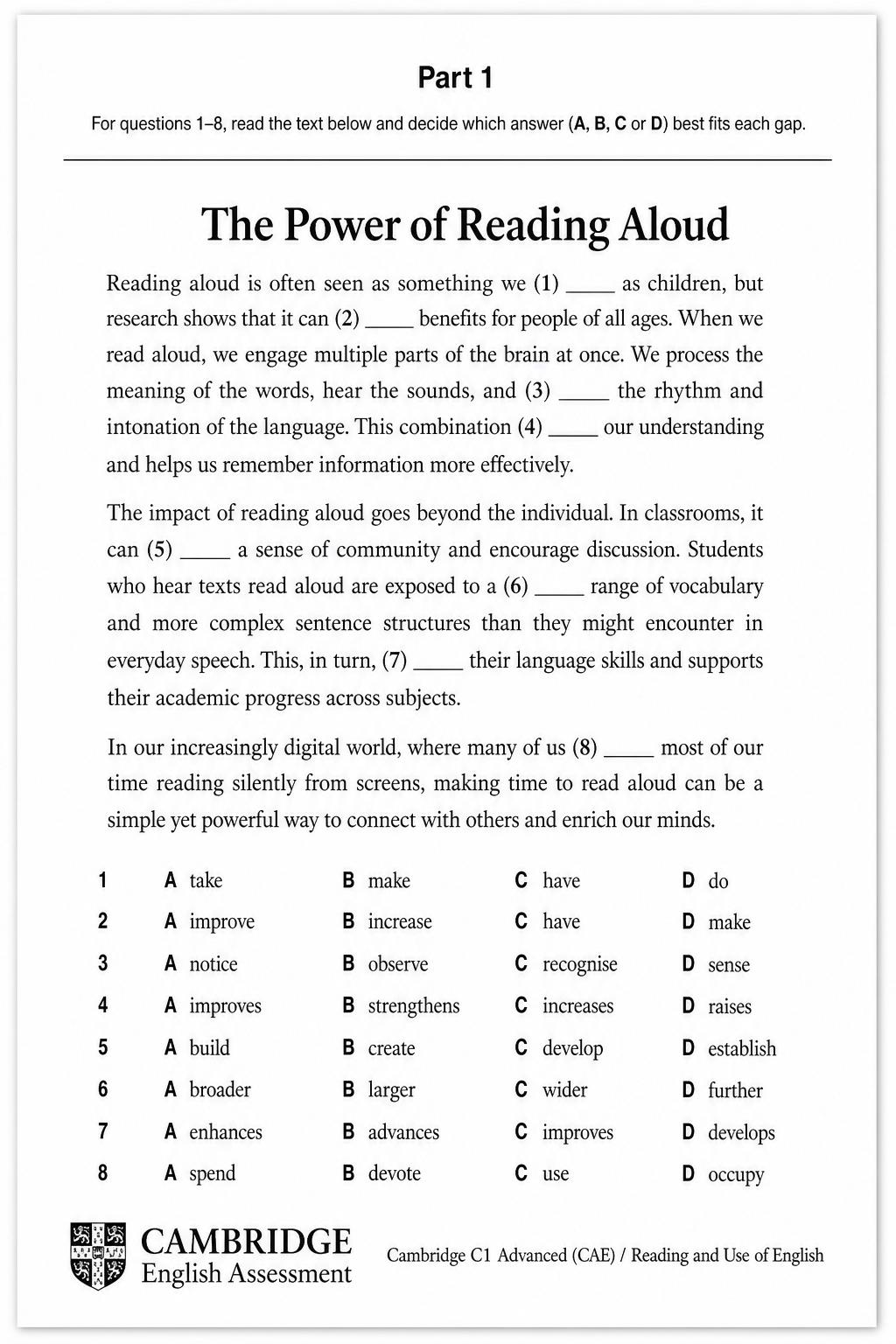
Discuss in pairs
In pairs, predict the answer for gap 1 BEFORE arguing. Then check against the strategy below.
R&UoE Part 1 — Multiple Choice Cloze, in depth
Strategy
- 1.Read the whole text once for gist — don't touch any gap.
- 2.For each gap, identify the part of speech and predict a word.
- 3.Test each option in the full sentence — listen for the collocation.
- 4.Ask: would a journalist or academic write this?
- 5.If stuck, eliminate the two clearly weakest options first.
Example
'The new policy has had a ___ effect on staff morale.' A) big B) profound C) wide D) full. 'Profound effect' is fixed in formal English; 'big effect' is acceptable but informal. Answer: B.
Practice · Section 9
7 minFill in the blank
Question 1.The committee has decided to ___ steps to address the issue.
Question 2.Her work is widely ___ as the best in the field.
Question 3.There has been a ___ improvement in the team's performance this quarter.
Question 4.It's still too early to ___ any firm conclusions.
Question 5.The report is broadly in ___ with our existing strategy.
Question 6.She made a ___ contribution to the success of the project.
Question 7.Several team members ___ objections to the proposed timeline.
Question 8.We need to ___ further research before we make a final decision.
Q1.Open Cloze (one word): 'There has been a marked increase ___ enquiries this quarter.'
Q2.Word Formation. Root: CONCLUDE. 'It's too early to draw any firm ___ from the data.'
Q3.Key Word Transformation. Original: 'Most people think she's the best designer in the company.' Use REGARDED. Rewrite: 'She is widely ___ best designer in the company.'
Writing · Section 10
4 minPut it in writing
INTERNAL MEMORANDUM · People & Operations
Re: New flexible-working policy — staff briefing
Draft circulated to the writing team. Please rewrite at C1 register before publication.
Ops · 12 March
The new policy is a big change. It has a good effect on the team. Some people think it is the best policy of the year.
We did a lot of research before we made the decision. Now we need to do steps to make sure everyone understands it.
Your notes
- ✎ Too informal — 'big change' / 'good effect' won't pass C1 register check.
- ✎ Add at least one hedge ('broadly', 'it would be premature to…').
Your task
Rewrite the B2 internal memo at C1, replacing weak collocations with stronger ones from today. 100–120 words.
- • Respond to the memo above — same content, C1 register.
- • Aim for ≥4 stronger collocations (marked shift, profound effect, widely regarded, drawn conclusions…).
Before you submit
- ☐ Replace 'big change' with a stronger collocation.
- ☐ Replace 'good effect' with a precise C1 collocation.
- ☐ Use at least one hedge (broadly / it would be premature to…).
- ☐ Word count 100–120.
Show model answer
The new policy represents a marked shift for the team. Broadly speaking, it has had a profound effect on how we work — particularly on collaboration across departments. It is, indeed, widely regarded as one of the most significant changes the company has introduced this year, although it would be premature to draw any firm conclusions about its long-term impact. We carried out extensive research before reaching the decision, and we are now taking concrete steps to ensure that every team member understands what the change means in practice and, just as importantly, why it was made.
Make it a real conversation
Speaking Part 3 mini-lab. Pairs, 3 minutes: use the board below to reach a joint conclusion. Use ≥4 collocations from today.
CAE Speaking Part 3 collaborative task. Discuss EACH option, then agree on ONE.
Which has had the most profound effect on how people work in the last decade?
Smartphones
Always-on culture; blurred boundaries.
Remote working
Re-shaped where and how teams meet.
AI tools
Changing what 'doing the work' means.
Social media
Reputation, recruitment, distraction.
Useful phrases
- I'd say that has had a profound effect on…
- It's widely regarded as…
- We can probably draw the conclusion that…
- Broadly speaking, there's been a marked shift in…
- I'd raise an objection to that — partly because…
- Let's take a step back and…
- What we need to do is…
- Shall we draw a conclusion, then?
- AWhich do you think has had the biggest impact on work over the last ten years?
- B_______________
- AI'm not sure I agree. What about smartphones?
- B_______________
Optional · Teacher-led
Teacher Activities
Two collocation-building extensions for stronger groups or longer sessions. ~22 min total
Homework · Section 12
Take-homeTake it home
Highlight TEN adjective + noun collocations in the article below. List each one and what you noticed.
text · Article (≈300 words) — 'Why our cities need more trees'
Urban tree planting has become one of the most quietly significant environmental policies of the last decade. Once dismissed as a decorative concern, it is now widely regarded as a serious tool for tackling air pollution, urban heat and even mental wellbeing. The evidence is striking. A 2022 study by the World Resources Institute found that neighbourhoods with dense tree cover recorded a marked reduction in average summer temperatures — in some cases by as much as four degrees. The same study reported a noticeable improvement in self-reported wellbeing among residents living within walking distance of mature green space. Not everyone is convinced. Some city planners raise the obvious objection: trees take decades to mature, and the immediate benefit to a new resident is small. Others point to the heavy maintenance costs, particularly in cities with aggressive winter weather. There is also a growing concern that 'green washing' allows local councils to take symbolic action without addressing the deeper structural causes of urban pollution. Still, the broad consensus is shifting. Cities as different as Singapore, Paris and Medellín have made deliberate decisions to redirect significant portions of their public budgets towards long-term tree planting. Early results suggest a profound impact — not just on temperature and air quality, but on how residents feel about the city they live in. It would be premature, perhaps, to draw firm conclusions from a handful of cities. But the direction of travel is clear: trees, once a decorative afterthought, are increasingly seen as critical infrastructure. The question is no longer whether to plant them, but how quickly we can plant enough.
prompts · Find 10 collocations. For each:
- Write the full collocation (e.g. 'a marked reduction').
- Note what type it is (adj+noun, verb+noun, noun+prep).
- Star any you'd use in your own writing this week.
Below are 5 sentences with weak collocations. Rewrite each at C1 using a stronger collocation.
questions · Rewrite each sentence
- The new manager had a big effect on the team.
- Some people made objections to the proposal.
- We should make some research before we decide.
- The report is in line with our plans more or less.
- She is thought as one of the best designers in the company.
Build a collocation page for FIVE nouns. Under each, write every verb / adjective you've seen collocate with it.
vocab list · Your five nouns
- decision
- research
- responsibility
- effect
- contribution
prompts · For each noun
- List ≥3 verbs that collocate (e.g. decision: make, reach, come to).
- List ≥3 adjectives that collocate (e.g. decision: deliberate, tough, final).
- Write one personal example sentence.
Rewrite your 100-word personal statement from Lesson 1, this time including ≥4 C1 collocations from today and one dependent preposition phrase.
vocab list · Recycle ≥4 of these
- make a significant contribution to
- have a profound effect on
- draw a conclusion
- raise an objection
- be widely regarded as
- a marked improvement in
- take steps to (do)
- broadly in line with
Recap · Section 13
Wrap-upWhat you've learned
- R&UoE Part 1 is a collocation test in disguise — all four options usually mean roughly the same.
- Predict the kind of word the gap needs before you look.
- Test each option in the full sentence — listen for the collocation.
- Verb–noun collocations and dependent prepositions are the bedrock of Part 1.
- Strong C1 vocabulary is reliable combinations under pressure, not raw word counts.
Need more practice?
Extra Practice for the task types and language in this lesson. Optional — it never changes your progress.
Lesson complete
Mark this lesson done to save your progress.