
Module 2 · Grammar in Action · Lesson 07
R&UoE Part 2 Open Cloze
Grammar in discourse, not in isolation
Get talking · Section 1
4 minGet talking
Read aloud: 'Despite ____ rain, we went for a walk.' What ONE word fills the gap? Now invent two more sentences with one-word gaps and swap with a partner.
Look at these gaps: 'in ____ of', 'no sooner ____ I arrived', 'a person ____ I admire'. Are the answers grammar words or content words? What does that tell you about Part 2?
Group these into ADDITION / CONTRAST / RESULT / CONDITION: furthermore, whereas, hence, provided, moreover, nevertheless, thus, unless.
The 8 word-classes Part 2 tests (and how to spot them)
Quick rule
Don't search for vocabulary — PREDICT the word class. Part 2 gaps are almost always grammar words: prepositions, pronouns, auxiliaries, linkers, articles, relatives, comparatives or quantifiers.
Part 2 is the most predictable part of the whole paper. The eight gaps are NEVER lexical content words — they are grammatical glue: dependent prepositions (interested IN, accused OF, on behalf OF), relative pronouns (who, which, whose, where), reference pronouns (it, them, this, those), auxiliaries inside perfect / passive / inversion structures (had, been, having, did), conjunctions and linkers (although, despite, whereas, unless, provided), comparative or quantifier words (more, than, as, much, many, few, fewer), articles (a, the — rarely), and fixed-phrase fillers (in ORDER to, in SPITE of, by MEANS of). Your job is to read the surrounding words, name the class, then choose the single best item from that small set. If your candidate word would change form (suggested/suggesting), it's wrong — Part 2 only takes one base word, never a contraction.
Examples
Dependent preposition: 'She's been accused ____ stealing.' → OF
Relative pronoun: 'The colleague ____ desk is next to mine resigned.' → WHOSE
Reference pronoun: 'I bought two books and read ____ on the train.' → THEM / BOTH
Auxiliary in inversion: 'No sooner ____ we arrived than it rained.' → HAD
Linker / conjunction: '____ the rain, the match went ahead.' → DESPITE
Comparative pairing: 'The more you practise, ____ better you get.' → THE
Fixed phrase: 'She was promoted on the ____ of her sales record.' → BASIS
Quick check
Question 1.'He's interested ____ learning Japanese.' (ONE word)
Question 2.'No sooner ____ we sat down than the phone rang.' (ONE word)
Question 3.'The candidate ____ CV impressed us most was Sara.' (ONE word)
Question 4.'____ the weather, the festival went ahead.' (ONE word)
Question 5.Which of these would NEVER be a valid Part 2 answer?
Build the sentence → spot the natural chunks → say it aloud → reply like a real conversation.
1.Rebuild an inversion clause for 'No sooner ___ we arrived…' (the missing word is HAD).
2.Rebuild a relative clause: 'a colleague ___ desk is next to mine' (the missing word is WHOSE).
3.Rebuild a fixed phrase: 'on the ___ of her sales record' (the missing word is BASIS).
Quick check 1.How many words may go in EACH Part 2 gap?
Quick check 2.True or false: contractions like DON'T count as one word in Part 2.
Words & phrases to own
despite / in spite of
contrast linker followed by a noun or -ing form
Use it now
Say one sentence that is true about you using this expression.
whereas / while
contrast conjunctions linking two clauses
Use it now
Say one sentence that is true about you using this expression.
provided / providing (that)
conditional connector meaning 'only if'
Use it now
Say one sentence that is true about you using this expression.
on behalf of
fixed phrase = 'representing someone'
Use it now
Say one sentence that is true about you using this expression.
by means of
fixed phrase = 'using' (formal)
Use it now
Say one sentence that is true about you using this expression.
in the event of
fixed phrase = 'if X happens' (formal)
Use it now
Say one sentence that is true about you using this expression.
whose
relative pronoun of possession (people OR things)
Use it now
Say one sentence that is true about you using this expression.
the more… the more
double-comparative structure with two THEs
Use it now
Say one sentence that is true about you using this expression.
Tap an item on the left, then tap its match on the right.
Pronunciation · Section 4
3 minWeak forms in grammar words
Most Part 2 answers are grammar words — and in connected English, grammar words use WEAK forms (schwa /ə/). Saying the completed sentence aloud with natural rhythm helps you feel whether the missing word is really a grammar word at all. If the word in your head wants to be STRESSED, it's probably a content word and almost certainly the wrong choice.
- 'She was accused OF stealing.' — OF reduces to /əv/, not /ɒf/.
- 'No sooner HAD we arrived than it rained.' — HAD reduces to /həd/.
- 'I bought THEM yesterday.' — THEM reduces to /ðəm/.
- 'The more you eat, THE bigger you get.' — both THEs reduce.
- 'DESPITE the rain, we went out.' — stress on de-SPITE then a long pause.
Reading · Section 5
8 minThe Living City: A New Language of Architecture
For decades, the standard architectural paradigm was one of dominance. Man-made structures were designed to stand out against their environment, as if to assert human ingenuity over the natural world. This was the era of the glass skyscraper, where glimmering facades reflected the sky while keeping the elements firmly at bay. However, a significant shift in perspective is currently underway. Architects are increasingly viewing buildings not as isolated monuments, but as integral components of a wider ecological system.
This transition is not merely aesthetic; it is a fundamental reimagining of what a building is for. Provided that a structure can serve its inhabitants without depleting the planet’s resources, it is now considered a success. This has led to the rise of biophilic design, a methodology that seeks to incorporate natural elements—light, air, and vegetation—into the very fabric of our living spaces. The more we understand the psychological benefits of being near nature, the more we realise that our sterile offices and concrete jungles are, by means of their very design, detrimental to our well-being.
Despite the obvious benefits, this movement faces hurdles. In spite of advancements in green technology, many developers remain hesitant, fearing that the maintenance of vertical gardens or integrated wetlands will be prohibitively expensive. There is also the issue of urban density. While a suburban housing project might easily accommodate a communal garden, a city-centre high-rise faces far greater constraints. In the event of a conflict between floor space and green space, the former almost always wins in the eyes of the investor.
Nevertheless, the tide is turning. We are seeing projects where the building’s skin acts as a living organism, filtering rainwater and purifying the air on behalf of the entire neighbourhood. These structures are not just places to work or live; they are active participants in the local climate. Such innovation is often driven by architects whose primary motivation is as much ecological as it is artistic.
Ultimately, the goal is a form of 'regenerative' architecture. Whereas previous generations sought to minimise the damage done to the environment, today’s visionaries want to go further. They hope to create buildings that actually improve the land they sit on. This requires a move away from the 'grammar' of traditional construction—where every brick and beam is a separate, static entity—and towards a more fluid, interconnected way of thinking. In this new discourse, the spaces between buildings are just as important as the buildings themselves. Provisioning for a sustainable future is no longer a niche concern; it is the central pillar of modern design.
Question 1.What is the primary purpose of the first paragraph?
Question 2.What is suggested about the 'glimmering facades' of modern buildings?
Question 3.What does the author imply about 'biophilic design'?
Question 4.Which of the following ideas is reflected in the phrase 'the more... the more' in the context of the passage?
Question 5.How does the author characterize the 'Green Wall' initiative?
Question 6.What is the author's conclusion about the future of architectural philosophy?
Q1.The author suggests that historical architecture often sought to highlight human achievement rather than blend with nature.
Q2.The text concludes that biophilic design is primarily a method for reducing the initial costs of construction.
Q3.The text implies that investors often prioritise commercial viability over environmental features.
Q4.The passage states that traditional developers are universally supportive of green technology due to its low maintenance costs.
Listening · Section 6
8 minThe Urban Green Lung Project
Listening audio
Tap play to listen. Replay as many times as you need.
Show transcript
Priya (RP, f):Welcome back. Today we’re discussing the ‘Urban Green Lung’ initiative. With me are Isla, a city planner, and Callum, an environmental advocate.
Isla, the project has faced some stiff opposition, hasn't it?
Isla (Scottish, f):It has, Priya, and to be fair, that’s to be expected with a project of this scale. The more we delve into the logistics, the more we realise how many stakeholders are involved. Most of the pushback isn't about the trees themselves, but rather the disruption to transit routes.
Callum (Scottish, m):If I could just jump in there—disruption is a small price to pay. Provided that the council sticks to its original carbon-neutral pledge, these arterial closures are essential. We’re acting on behalf of future generations who won't have the luxury of debating 'convenience' when the heat islands become unbearable.
Isla (Scottish, f):I don't disagree with the sentiment, Callum, but we have to be pragmatic. While you see it as a moral imperative, a local business owner sees a delivery truck that can’t reach their shop. In the event of a total pedestrianisation, some of these small family firms might fold within months.
Callum (Scottish, m):But surely it's a matter of adaptation? We’ve seen in other European capitals that footfall actually increases. It’s not as if we’re cutting people off by means of some arbitrary wall; we’re inviting them to walk.
Is it not true, Isla, that the initial data from the pilot scheme was actually quite promising?
Isla (Scottish, f):The data was nuanced. Footfall rose, yes, but the average spend per head dropped. It seems people enjoy a stroll in the park, whereas they tend to do their serious heavy lifting—commercially speaking—where they can park nearby.
We need a middle ground, perhaps a smarter use of timing.
Priya (RP, f):So, are you suggesting the project is being scaled back?
Isla (Scottish, f):Not exactly. Despite the vocal minority calling for a complete U-turn, we are proceeding. We are just, shall we say, refining the parameters.
For instance, the bus lanes will remain operational during peak hours. Some activists, whose primary concern is total car-free zones, might find that a bitter pill to swallow.
Callum (Scottish, m):A bitter pill indeed. It feels like a dilution of the vision. If we keep making concessions, we'll end up with a few expensive flowerpots instead of a 'green lung'.
We need to be bolder.
Priya (RP, f):Isla, what's your response to that? Is the vision being lost?
Isla (Scottish, f):I’d say it’s being 'urbanised'. A park in the middle of a forest is easy; a park in the middle of a financial district requires a level of compromise that pure environmentalism often struggles to reconcile with. It’s about balance.
Priya (RP, f):Well, it certainly sounds like there is still a significant bridge to be built between the two camps. Thank you both for your time.
Question 1.What is Isla’s attitude toward the opposition the project has received?
Question 2.What is Callum's main argument regarding the disruption caused by the project?
Question 3.What point does Isla make about the pilot scheme?
Question 4.How does Isla defend the decision to modify the project's original plans?
Question 5.In the final part of the discussion, Callum feels...
Question 6.Which of the following best summarises the overall theme of the interview?
Question 1.The tutor's overall message about Part 2 is best summarised as…
Visual stimulus · Section 7
3 minA real Part 2 page
30 seconds of silent scanning. For EACH numbered gap, predict the WORD CLASS first: preposition, pronoun, auxiliary, linker, comparative or fixed-phrase word.
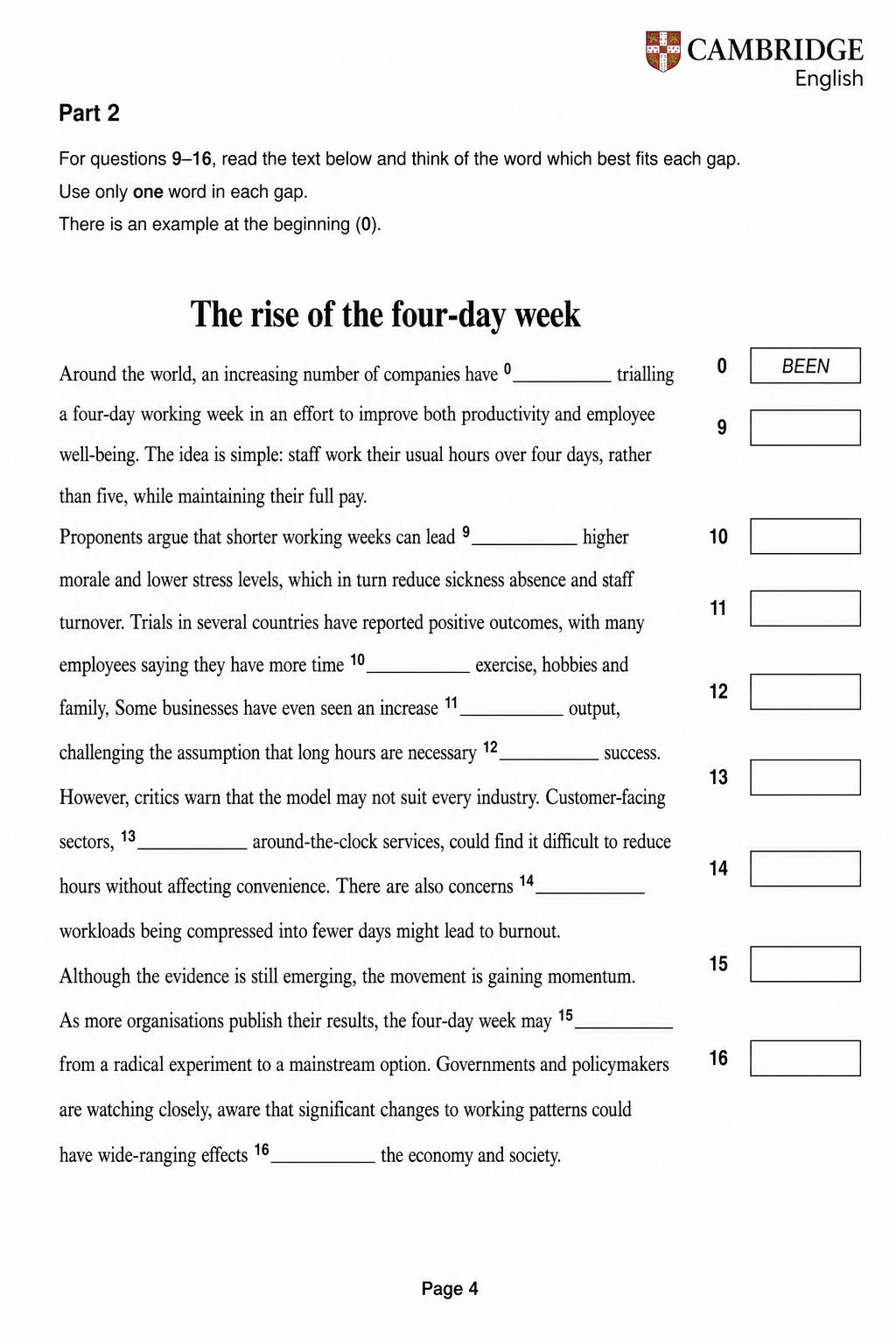
Discuss in pairs
In pairs, label each of gaps 9–16 with a class, then propose your one-word answer. Only commit once you've read the sentence aloud with your word in it.
R&UoE Part 2 — Open Cloze, in depth
Strategy
- 1.Scan the WHOLE text for 30 seconds before writing anything.
- 2.At each gap, NAME the word class out loud: preposition / pronoun / auxiliary / linker / relative / comparative / fixed phrase.
- 3.Choose ONE word that fits the class — no contractions, no compounds.
- 4.Read the completed sentence aloud — if cohesion sounds broken, change the word.
- 5.If two grammar words fit, pick the more frequent one (e.g. THAT over WHICH in defining clauses).
Example
'She was accused ____ stealing the documents.' Class: preposition (after ACCUSE). Candidates: OF / FOR / WITH. Read aloud: 'accused OF stealing' is a known chunk. Commit: OF. One word, no contraction, cohesion intact.
Practice · Section 9
7 minFill in the blank
Question 1.She has been interested ____ photography since she was a teenager.
Question 2.____ the heavy rain, the outdoor concert went ahead as planned.
Question 3.The author, ____ latest novel won a major prize, will be at the festival.
Question 4.No sooner ____ we sat down than the waiter brought the menu.
Question 5.The more time you spend revising, ____ better your results will be.
Question 6.____ that you book in advance, you can travel for half the price.
Question 7.Concerns have been raised ____ the impact of the new policy on small firms.
Question 8.I bought two new novels and read ____ on the flight home.
Q1.Fill the gap with ONE word: 'In ____ of the bad weather, the match went ahead.'
Q2.Fill the gap with ONE word: 'She speaks on ____ of the whole team.'
Q3.Fill the gap with ONE word: 'It's a long time ____ I last saw you.'
Q4.Fill the gap with ONE word: 'There is little ____ no evidence to support the claim.'
Writing · Section 10
4 minPut it in writing
Your task
Take any paragraph (80–100 words) you wrote recently — an email, a message, or a paragraph from this course — and rewrite it with EIGHT deliberate cohesive devices added or improved: at least two linkers, two reference pronouns, two dependent prepositions used naturally, and two fixed phrases (e.g. 'on the basis of', 'in spite of', 'as a result of').
- • Submit BOTH the original and the rewrite, marked side by side.
- • Underline or label each of the eight cohesive devices you added.
- • Don't pad the paragraph — keep the length within ±10% of the original.
Before you submit
- ☐ Original and rewrite both visible.
- ☐ At least 8 cohesive devices added, all clearly labelled.
- ☐ No contractions used in formal sentences.
- ☐ Read the rewrite aloud — every sentence still flows naturally.
Show model answer
Original (78 w): 'I started a new job last month. It's busy. I like my colleagues. The office is far from my flat. I take the train every morning. Sometimes I read on the way. Sometimes I just look out of the window. Either way, I usually arrive feeling ready to start the day.' Rewrite (84 w): 'I started a new job last month, AND ALTHOUGH it is busy, I genuinely like the colleagues WITH whom I share an open-plan office. THE OFFICE itself is some way from my flat, SO I take the train every morning. ON the journey, I sometimes read; ON OTHER DAYS I simply look out of the window. EITHER WAY, BY THE TIME I arrive, I'm usually ready to start the day.'
Make it a real conversation
Justify-your-one-word pairs. In pairs, take turns: Student A reads a sentence with a one-word gap aloud. Student B must (a) name the word class, (b) propose the word, and (c) justify the choice in one sentence. Swap each round. Time: 6 minutes.
Useful phrases
- I think the class is… because…
- It has to be a preposition / pronoun / auxiliary…
- The collocation here is…
- It's a fixed phrase: '____ ____ of'.
- If I read it aloud, 'X' sounds wrong because…
- Another possible word would be… but…
- The discourse marker has to signal contrast / result / condition.
- It can't be a content word here because…
- A'She was accused ____ taking documents without permission.'
- B_______________
- A'____ the high cost, demand for the new model is still rising.'
- B_______________
- A'The writer, ____ books I grew up with, will give a talk tonight.'
- B_______________
Optional · Teacher-led
Teacher Activities
Two extensions for stronger groups or longer sessions. ~22 min total
Homework · Section 12
Take-homeTake it home
Complete EIGHT one-word Part 2 gaps. For each item, first name the WORD CLASS in brackets, then write the answer.
questions · Eight items (one word per gap)
- 1. The decision was taken on the ____ of the latest sales figures.
- 2. She apologised ____ being late to the meeting.
- 3. ____ the team had trained for months, they lost in the final.
- 4. No sooner ____ I closed the door than the phone rang.
- 5. The candidate ____ qualifications match the role best is Mariam.
- 6. We won't go ahead ____ everyone agrees on the budget.
- 7. The longer we wait, ____ harder the decision becomes.
- 8. The new policy will have a serious effect ____ small businesses.
Build a one-page 'Part 2 prediction map'. For EACH of the 8 word classes, write the trigger contexts you'd expect to see and ONE model gap with the answer.
vocab list · Eight classes to cover
- Dependent preposition (verb + prep, adj + prep, noun + prep)
- Relative pronoun (who, which, whose, where, when)
- Reference pronoun (it, them, this, those, both, either)
- Auxiliary (had, been, having, did, do, does)
- Linker / conjunction (although, despite, whereas, unless, provided)
- Comparative / quantifier (more, than, as, much, few, fewer)
- Fixed-phrase noun or particle (spite, behalf, basis, means, event)
- Article (a, an, the — used sparingly)
prompts · For each class
- List 3 trigger contexts that usually signal it.
- Write ONE model sentence with a gap, and write the answer in brackets.
- Mark the class you find HARDEST — that's tomorrow's first drill.
Find a short article (150–200 words) from a quality news site. Choose EIGHT grammar words across the article and rewrite the article as a Part 2 cloze: replace each chosen word with a gap. Then write the answer key.
prompts · Include
- The original article URL or source.
- Your cloze version with 8 numbered gaps.
- Your answer key labelling the class of each gap.
Record yourself (60–90 seconds) explaining ONE word class to an imaginary classmate as if you were the teacher. Name the class, give the trigger contexts, model one example aloud, and warn about the most common mistake students make with it.
prompts · Cover, in this order
- Name the word class.
- Give 2–3 trigger contexts.
- Say one full model sentence with the gap and answer aloud.
- Warn about the most common error (e.g. using a contraction, writing two words).
Recap · Section 13
Wrap-upWhat you've learned
- Part 2 = 8 gaps, 1 mark each (max 8), ONE word per gap — no contractions, no compounds.
- Almost every answer is a grammar word: preposition, pronoun, auxiliary, linker, relative, comparative, fixed-phrase word.
- Routine: scan the text → name the word class → choose the word → read the sentence aloud → verify cohesion.
- Most errors are routine errors (contraction, wrong class, two words), not knowledge errors.
- Cohesion repair is a real-world editing skill — train it on the page and your writing tightens up too.
Need more practice?
Extra Practice for the task types and language in this lesson. Optional — it never changes your progress.
Lesson complete
Mark this lesson done to save your progress.