
Module 2 · Grammar in Action · Lesson 08
Listening Part 2 Notes & Detail
Sentence completion from extended monologue
Get talking · Section 1
4 minGet talking
Listen as your partner reads ONE short sentence aloud at natural speed. Write down the exact final noun. Swap roles. What was hardest — hearing, holding it in memory, or spelling it?
Look at these gaps: 'She lives in ____.' / 'The course lasts ____ weeks.' / 'His new book is called ____.' For each, name the type of word that must fit: place, number, title?
Pair these: 'a lot of people / a huge crowd', 'started / kicked off', 'the main reason / what really drives it'. Which version is more likely on the page; which in the audio?
Predicting the missing word class in Part 2
Quick rule
Before play 1, label every gap: NOUN / NUMBER / NAME / ADJECTIVE / VERB-ing. The class tells your ear what to listen for.
Part 2 isn't a listening test in the raw sense — it's a prediction test that uses a listening text. The eight printed sentences are paraphrases of what the speaker says, but the answers themselves are lifted verbatim. Strong candidates spend the 45-second pre-listening window doing one thing: labelling each gap with the WORD CLASS it must take. A gap after 'a lack of ____ in city parks' must be a plural noun (wildflowers / pollinators / habitats). A gap after 'studying ____ at university' must be a subject noun (marine biology / botany / zoology). A gap before 'neighborhoods' must be an adjective (industrial / residential / poorer). Once your ear knows the class, it locks onto the right word and ignores the rest of the sentence. Without prediction, the speaker's surrounding words pull your pen toward the wrong noun in the same sentence.
Examples
'lasts ____ weeks' → NUMBER (e.g. eight)
'a course called ____' → PROPER NOUN / TITLE (e.g. BeeWatch)
'lack of ____ in parks' → PLURAL NOUN (e.g. wildflowers)
'studying ____ at university' → SUBJECT NOUN (e.g. marine biology)
'even in ____ neighborhoods' → ADJECTIVE (e.g. industrial)
'inspire more ____ to keep bees' → PLURAL NOUN — people (e.g. city dwellers)
Quick check
Question 1.What word class fits: 'The trip cost £____ per person.'?
Question 2.What word class fits: 'He works for an organisation called ____.'?
Question 3.What word class fits: 'There is a serious lack of ____ in the area.'?
Question 4.What word class fits: 'They live in a very ____ part of the city.'?
Question 5.In Part 2, the answers you write are…
Quick check 1.How many times do you hear the Part 2 audio?
Quick check 2.How many words may go in a Part 2 gap?
Words & phrases to own
pollinator
an insect (often a bee) that carries pollen between plants
Use it now
Say one sentence that is true about you using this expression.
habitat
the natural home of a plant or animal
Use it now
Say one sentence that is true about you using this expression.
wildflower
a flower that grows naturally, without being planted by people
Use it now
Say one sentence that is true about you using this expression.
rooftop hive
a beehive kept on the roof of a building, common in cities
Use it now
Say one sentence that is true about you using this expression.
biodiversity
the variety of plant and animal life in a place
Use it now
Say one sentence that is true about you using this expression.
citizen science
scientific data collected by ordinary members of the public
Use it now
Say one sentence that is true about you using this expression.
attitudes (towards)
the way people feel or think about something
Use it now
Say one sentence that is true about you using this expression.
city dweller
a person who lives in a city
Use it now
Say one sentence that is true about you using this expression.
Tap an item on the left, then tap its match on the right.
Pronunciation · Section 4
3 minCatching unstressed content words and proper nouns
In a Part 2 monologue, the answer is almost always a stressed content word — but it's surrounded by faster, less stressed speech. Two specific traps: (1) proper nouns and app/product names are said ONCE, often quickly, and rarely repeated. (2) noun phrases like 'city dwellers' or 'marine biology' are stressed on the FIRST word, so untrained ears miss the second. Train yourself to write the whole chunk, not just the word you heard first.
- 'CITY dwellers' — main stress on CITY, but the answer is two words.
- 'MARINE biology' — both words needed; the second is unstressed.
- 'an app called BEE-watch' — said once, no repetition.
- 'lavender' — three syllables, but stressed on the first: LA-ven-der.
- 'pollinating plants' — '-ing plants' can collapse to '-in plants'; don't drop the noun.
Reading · Section 5
8 minThe Urban Harvest: Rethinking the City as a Sanctuary
The concrete jungle has long been a metaphor for biological sterility, a place where nature is paved over in the name of progress. However, a growing movement of ecologists and urbanites is challenging this narrative, asserting that the city may well be the final frontier for conservation. Central to this shift is the recognition of the role played by the pollinator. In an era where rural monocultures are increasingly hostile to insect life due to pesticide use and the loss of hedgerows, the messy, varied gardens of city dwellers are becoming vital refuges.
The rise of the rooftop hive is perhaps the most visible indicator of this change. Once the preserve of eccentric hobbyists, urban beekeeping has entered the mainstream. Yet, experts warn against a simplistic view of this trend. While honeybees are charismatic ambassadors for the environment, they represent only a fraction of the necessary biodiversity. The real challenge lies in supporting a wide array of wild pollinators, many of which have highly specific habitat requirements that a standard hive cannot provide. There is a nuanced danger that by overpopulating cities with honeybees, we may inadvertently create a competitive environment where native, solitary species are outcompeted for limited floral resources.
To mitigate this, the focus is shifting toward the creation of 'pollinator paths' or wildflower corridors. These are not merely aesthetic choices; they are functional infrastructure designed to link fragmented green spaces. This is where citizen science plays a pivotal role. By engaging the public in monitoring species and tracking the health of these corridors, researchers gain access to a scale of data that would be impossible to collect alone. Moreover, this participation fosters a change in public attitudes, transforming the way people perceive 'weeds' and unkempt verges. A dandelion in a sidewalk crack is no longer an eyesore to be eradicated, but a crucial food source to be protected.
However, the path to a truly green city is fraught with corporate 'social washing.' Some developers are quick to add a single green roof to a massive glass-and-steel complex, claiming environmental leadership while doing little to support a genuine ecosystem. True biodiversity requires more than just a token gesture; it demands a holistic approach to urban planning where habitat creation is baked into the building codes. This includes the use of native plantings over ornamental exotics and the provision of nesting sites for a variety of insects, not just the commercially viable ones.
Ultimately, the success of urban conservation hinges on long-term commitment. It is not enough to plant a wildflower meadow and walk away. Constant stewardship—the unglamorous work of weeding, watering, and monitoring—is what ensures these spaces thrive. As the urban population continues to grow, the pressure on these tiny pockets of nature will only increase. The goal must be to move biodiversity from the margins of the architectural blueprint to its very center, ensuring that the city of the future is as much a home for the bee as it is for the human.
Question 1.The writer's primary purpose in the first paragraph is to...
Question 2.What does the author suggest is a 'nuanced' challenge of urban beekeeping?
Question 3.Regarding 'citizen science,' what point is made in the third paragraph?
Question 4.In the context of the fourth paragraph, 'social washing' refers to...
Question 5.The mention of 'weeding' is used to...
Question 6.The final paragraph suggests that the ultimate goal for urban biodiversity is...
Q1.The author suggests that urban environments can sometimes offer a safer haven for insects than modern agricultural areas.
Q2.The passage argues that increasing the number of honeybee hives is the most effective way to save all pollinator species.
Q3.The text implies that public participation in data collection is essential for understanding urban ecological health.
Q4.The author believes that most green roofs currently installed by developers represent a genuine shift toward holistic urban planning.
Listening · Section 6
8 minThe Buzz of the City: A Debate on Urban Ecology
Listening audio
Tap play to listen. Replay as many times as you need.
Show transcript
Callum (Scottish, m):Welcome back. Today we're discussing urban ecology with Dr. Aris Thorne and urban bee-keeper, Fiona.
Fiona, you've been installing rooftop hives across the city. Is this just a passing fad for hipsters, or is there more to it?
Fiona (Scottish, f):Well, Callum, it’s easy to dismiss it as a trend, but if you look at the data, these hives are vital. City dwellers are often surprised to learn that urban centers can actually support more biodiversity than some rural monocultures. It’s about shifting public attitudes towards what a 'clean' city looks like.
Aris (RP, m):I’d have to jump in there, Fiona. While I admire the enthusiasm, there’s a risk of what we call 'social washing.' Are we just helping honeybees—which are essentially livestock—at the expense of the struggling wild pollinator? Passionate amateurs often overlook the competition for resources.
Fiona (Scottish, f):That’s a fair point, Aris, and I’ve certainly had to refine my own approach. Initially, I was all about maximum honey production. But now, my focus is on creating a network of wildflower corridors.
The rooftop hive is just the 'hook' to get people interested in the wider ecosystem.
Aris (RP, m):And that’s where citizen science comes in, isn't it? We need ordinary people to track which species are actually visiting these spaces. Without that data, we're just guessing.
We need to move beyond just 'liking' bees to actually understanding their habitat requirements.
Fiona (Scottish, f):Exactly. And it’s not just about the bees. When we plant for pollinators, we’re cooling the city and managing rainwater better.
It’s a holistic shift. I think the initial skepticism from biologists like yourself, Aris, has actually helped us professionalize the way we manage these urban projects.
Aris (RP, m):I appreciate that acknowledgement. I suppose my concern remains the 'set and forget' mentality. A hive isn't a silver bullet.
You can't just stick one on a roof and claim you've saved the planet. It requires long-term stewardship and, frankly, a lot of weeding of those wildflower patches!
Fiona (Scottish, f):Hardly a glamorous job, but necessary! What I’m seeing now, though, is a real hunger for knowledge among city dwellers. They don't just want a hive; they want to know the names of the solitary bees in their window boxes.
That shift in perspective is what will ultimately drive policy changes.
Callum (Scottish, m):So, we're looking at a future where urban planning puts biodiversity at the forefront, rather than as an afterthought?
Aris (RP, m):That's the dream. But it requires developers to see green space not as 'lost' square footage, but as an essential utility. It’s a hard sell in a high-rent environment, but the momentum is definitely building.
Fiona (Scottish, f):And we’re seeing that in the new building codes being proposed. It's an uphill struggle, but we're no longer just shouting into the wind. People are finally listening to the buzz, if you'll pardon the pun.
Callum (Scottish, m):On that note, I think we'll leave it. Fiona, Aris, thank you for a very illuminating discussion.
Question 1.In the first part of the discussion, Fiona suggests that...
Question 2.What concern does Aris raise regarding the current popularity of beekeeping?
Question 3.How has Fiona’s personal approach to beekeeping changed over time?
Question 4.What is the main benefit of citizen science according to the speakers?
Question 5.Aris and Fiona agree that...
Question 6.At the end of the dialogue, the speakers' tone regarding urban development is...
Question 1.Dr. Vance's overall message about urban beekeeping is best summarised as…
Visual stimulus · Section 7
3 minA real Part 2 page
45 seconds of silent preview. For EACH numbered gap (9–16), underline the words on either side and label the missing WORD CLASS: noun, number, name, adjective.
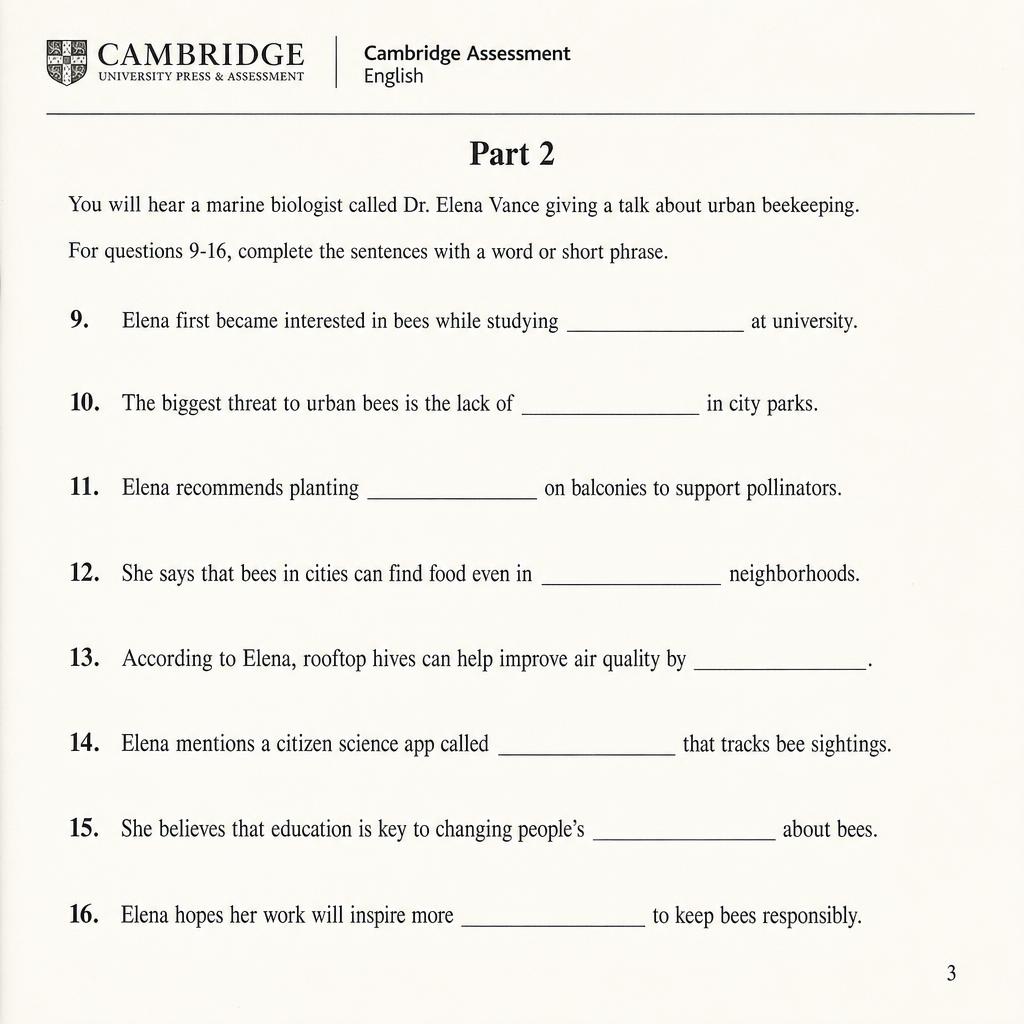
Discuss in pairs
In pairs, predict the class of each gap BEFORE the audio plays. After the audio, justify your answer with the exact wording you heard.
CAE Listening Part 2 — Sentence Completion, in depth
Strategy
- 1.PREVIEW for 45 seconds: read every sentence, underline the words around each gap, label the missing WORD CLASS.
- 2.Play 1 = CAPTURE: write something for every gap, even if you're unsure.
- 3.Play 2 = VERIFY: confirm exact wording, fix gaps, check spelling.
- 4.Write the SPEAKER'S exact words — never paraphrase, never translate.
- 5.If you wrote more than 3 words, you've over-written — cut to the core noun phrase.
Example
Printed: 'The biggest threat to urban bees is the lack of ____ in city parks.' Preview label: PLURAL NOUN (a thing bees need). Heard: 'what really endangers urban bees is just how few wildflowers we leave growing'. Write: WILDFLOWERS. NOT 'flowers', NOT 'plants' — the speaker's exact word.
Practice · Section 9
7 minFill in the blank
Question 1.Predict the class: 'The course lasts ____ weeks.' → the gap needs a…
Question 2.Predict the class: 'She works for an organisation called ____.' → the gap needs a…
Question 3.Predict the class: 'The main problem is the lack of ____ in the area.' → the gap needs a…
Question 4.Predict the class: 'They live in a very ____ part of town.' → the gap needs a…
Question 5.Predict the class: 'He started by studying ____ at university.' → the gap needs a…
Question 6.Predict the class: 'She recommends planting ____ on your balcony.' → the gap needs a…
Question 7.Predict the class: 'Her work helps to improve air quality by ____.' → the gap needs a…
Question 8.Predict the class: 'She hopes to inspire more ____ to take up beekeeping.' → the gap needs a…
Q1.From the audio: 'I actually started out studying ____ at university.' (2 words)
Q2.From the audio: 'The biggest threat is the lack of ____ in city parks.' (1 word)
Q3.From the audio: 'I always say: plant ____ on your balcony.' (1 word)
Q4.From the audio: 'A citizen science app called ____.' (1 word)
Writing · Section 10
4 minPut it in writing
Your task
Listen to the Dr. Vance monologue once more. Take rough notes in your own words, then rewrite ONE 80–100 word paragraph summarising her three main points. Then circle EVERY word in your paragraph that would NOT be accepted as a Part 2 answer (because it's a paraphrase, not her exact word).
- • Submit both the audio source and your written summary.
- • Circle every paraphrased word — these are the trap words in Part 2.
- • Add a short note: which of HER exact words would you have written in a Part 2 gap?
Before you submit
- ☐ Paragraph is 80–100 words.
- ☐ Every paraphrased word is circled.
- ☐ At least 5 of HER exact words are listed at the bottom.
- ☐ No invented details — only what she actually said.
Show model answer
Sample (94 w): 'Dr. Vance argues that urban bees are NOT mainly threatened by pesticides but by [the absence of] wildflowers in over-tidied city parks. She [advises] city dwellers to plant lavender on their balconies and [points out] that even [run-down] industrial neighborhoods can support bees if a single window box is in range. She also [highlights] the BeeWatch app for citizen scientists. Her [strongest] message is that educating children changes adult attitudes — and that [a few minutes] of weekly rooftop beekeeping can make city dwellers part of the solution.' Exact-word picks: wildflowers / lavender / industrial / BeeWatch / attitudes / city dwellers.
Make it a real conversation
Justify-your-transcription pairs. Student A reads aloud one printed Part 2 sentence with a gap. Student B says (a) the WORD CLASS that must fit, (b) the exact word they heard, and (c) one phrase from the audio that proves it. Swap each round. 7 minutes.
Useful phrases
- The gap has to be a [noun / number / name / adjective] because…
- I heard her say exactly '…' so the answer is…
- It can't be a synonym — Cambridge only accept her exact word.
- The trigger word right before the gap is…
- I almost wrote ____ but that's a paraphrase, not what she said.
- She only said it once — at about [minute] in.
- The class fits but the spelling needs checking…
- Reading the sentence aloud with that word, the cohesion is fine.
- A'I actually started out studying ____ at university.'
- B_______________
- A'The biggest threat is the lack of ____ in city parks.'
- B_______________
- A'I always say: plant ____ on your balcony.'
- B_______________
Optional · Teacher-led
Teacher Activities
Two extensions for stronger groups or longer sessions. ~22 min total
Homework · Section 12
Take-homeTake it home
Re-listen to the Dr. Vance monologue (or replay the audio in class). Complete the 8 Part 2 gaps from the visual stimulus page. For each one, also write in brackets the WORD CLASS you predicted before listening.
questions · Eight gaps to complete
- 9. Elena first became interested in bees while studying ____ at university.
- 10. The biggest threat to urban bees is the lack of ____ in city parks.
- 11. Elena recommends planting ____ on balconies to support pollinators.
- 12. She says that bees in cities can find food even in ____ neighborhoods.
- 13. According to Elena, rooftop hives can help improve air quality by ____.
- 14. Elena mentions a citizen science app called ____ that tracks bee sightings.
- 15. She believes that education is key to changing people's ____ about bees.
- 16. Elena hopes her work will inspire more ____ to keep bees responsibly.
Build a 'paraphrase map' for the 8 answers. For each exact-word answer, write the printed paraphrase and at least ONE other synonym Cambridge would NOT accept. This trains your ear to ignore paraphrases.
vocab list · For each of the 8 answers
- Exact word the speaker said (the only acceptable answer)
- Printed paraphrase wording from the page
- One synonym Cambridge would reject (your trap word)
Find a 2–3 minute monologue online (TED-Ed short, BBC Sounds clip, podcast intro). Write your OWN Part 2 page from it: 8 paraphrased sentences with gaps. Then write the answer key with the speaker's EXACT words.
prompts · Include
- The source URL and speaker's name.
- Eight paraphrased printed sentences (numbered 9–16) with one-to-three-word gaps.
- An answer key with the speaker's exact words AND the word class of each gap.
Record yourself (60–90 seconds) walking an imaginary classmate through your preview routine for one Part 2 page. Show them — out loud — how you decide what word class fits each gap BEFORE the audio starts.
prompts · Cover, in this order
- Read one printed sentence aloud.
- Name the words on either side of the gap.
- State the WORD CLASS that must fit and why.
- Predict ONE example word you might hear.
- Warn the listener about the biggest mistake to avoid (paraphrasing).
Recap · Section 13
Wrap-upWhat you've learned
- Part 2 = 8 sentence-completion gaps, 1 mark each (max 8), ONE to THREE words per gap.
- Answers must be the speaker's EXACT words — synonyms and paraphrases are marked wrong.
- You hear the audio TWICE. Play 1 = capture; Play 2 = verify and check spelling.
- The 45-second PREVIEW is the most important phase — label every gap with its word class.
- Trap: the printed sentence is a paraphrase, not a transcript. Listen for the speaker's exact wording, not the printed wording.
Need more practice?
Extra Practice for the task types and language in this lesson. Optional — it never changes your progress.
Lesson complete
Mark this lesson done to save your progress.