
Module 3 · Word Power · Lesson 09
Word Formation in Depth
Suffixes, prefixes and internal change
Get talking · Section 1
4 minGet talking
In pairs, you have 60 seconds. From the root DECIDE, write down every other word in the family: noun, verb, adjective, adverb, negative forms. Compare totals.
Which two of these formations are wrong? 'unpossible', 'misunderstand', 'disagree', 'inhonest', 'overreact'. Why do English speakers reject them?
Read aloud: 'Her ANALYSIS was sharp.' / 'She ANALYSED the data.' / 'It was an ANALYTICAL piece.' What changes — meaning, or grammar role?
The four-form word family
Quick rule
Every C1 root has up to four core forms: noun · verb · adjective · adverb. The gap's grammar tells you which form to write.
CAE Part 3 doesn't test vocabulary breadth — it tests vocabulary DEPTH. Each gap gives you a root in capitals (e.g. ABLE) and a sentence frame. Your job is two-fold: (1) read the surrounding grammar to identify which WORD CLASS the gap needs — noun, verb, adjective, adverb — and (2) form that class correctly from the root, including any prefix needed for meaning. Strong candidates do this in seconds because they already store vocabulary as four-form families. Weak candidates store words as items ('decide') and have to re-derive the family under exam pressure. The fastest fix is to record every new C1 word with its three or four relatives, marking stress: deCIDE (v) → deCIsion (n) → deCIsive (adj) → deCIsively (adv). Once the family lives in memory, the gap fills itself.
Examples
ABLE → 'are BETTER ABLE to survive' (comparative adjective phrase needed).
RESEARCH → 'RESEARCHERS around the world' (plural noun — person).
COMMUNICATE → 'their own way of COMMUNICATION' (noun after 'of').
SURPRISE → 'one of the most SURPRISING findings' (adjective after superlative).
INTENSE → 'remarkably INTENSE' (the original adjective fits, no change).
IMAGINE → 'it is hard to IMAGINE the impact' (verb after 'to').
Quick check
Question 1.ABLE → 'Seedlings connected to mature trees are ____ to survive in harsh conditions.'
Question 2.RESEARCH → 'Over the past few decades, ____ around the world have uncovered remarkable evidence.'
Question 3.COMMUNICATE → 'Forests have their own way of ____.'
Question 4.SURPRISE → 'One of the most ____ findings is that trees transmit chemical signals.'
Question 5.IMAGINE → 'It is hard to ____ the impact our actions may have.'
Quick check 1.What does Part 3 test?
Quick check 2.How many gaps in Part 3?
Words & phrases to own
noun-forming suffix
an ending that turns a word into a noun: -tion, -ment, -ance, -ity, -ness
Use it now
Say one sentence that is true about you using this expression.
adjective-forming suffix
an ending that turns a word into an adjective: -ous, -al, -ive, -able, -ful, -less
Use it now
Say one sentence that is true about you using this expression.
adverb-forming suffix
almost always -ly (added to an adjective)
Use it now
Say one sentence that is true about you using this expression.
negative prefix
un-, in-, im-, dis-, mis- — flips the meaning of the root
Use it now
Say one sentence that is true about you using this expression.
intensifying prefix
over-, under-, re-, mis- — modifies degree or repetition, not polarity
Use it now
Say one sentence that is true about you using this expression.
internal change
the root itself changes form: long → length, deep → depth, high → height
Use it now
Say one sentence that is true about you using this expression.
word family
all the related words built from one root: decide / decision / decisive / decisively
Use it now
Say one sentence that is true about you using this expression.
stress shift
the stressed syllable moves when a suffix is added: PHOto → phoTOgraphy
Use it now
Say one sentence that is true about you using this expression.
Tap an item on the left, then tap its match on the right.
Pronunciation · Section 4
3 minStress shift across the word family
When you add certain suffixes, the stress on the root moves. This matters in speaking AND in spelling — a wrong stress often produces a wrong vowel. Drill the whole family aloud, not the words in isolation.
- PHOto → phoTOgraphy → photoGRAPHic
- ANalyse → aNALysis → anaLYTical → anaLYTically
- ECOnomy → ecoNOMic → ecoNOMically
- BIology → bioLOGical → bioLOGically
- deCIDE → deCIsion → deCIsive → deCIsively (stress stays put)
Reading · Section 5
8 minLinguistic Architecture: The Rise and Fall of Corporate Jargon
The evolution of corporate communication is often viewed through the lens of 'professionalization', a process frequently marked by the 're-invention' of brand identities. Historically, many firms suffered from a form of linguistic 'stagnation', where a 'misunderstanding' of clarity led to an 'over-reliance' on complex, Latinate structures. In the pursuit of 'orderliness' and 'reliability', organizations heavily utilized 'noun-forming suffixes'—turning active, vibrant verbs into static, heavy concepts. This era of 'nominalization' was intended to project 'strength' and 'permanence', yet it often resulted in a disconnect between the 'intent' of the board and the 'readiness' of the workforce.
Key to this transition was the use of the 'intensifying prefix'. During the height of the bureaucratic age, terms like 'hyper-efficiency' and 'ultra-transparency' became commonplace. However, as critics have noted, such 'word families' often lacked the 'depth' they claimed to possess. The 'length' of the documents produced was frequently inversely proportional to the actual 'usefulness' of the information contained within. Employees found themselves navigating a maze of 'adjective-forming suffixes' like '-ive' and '-al', creating a world of 'evaluative' and 'functional' processes that felt increasingly 'un-productive'.
The 'un-doing' of this rigid system began with the rise of the digital start-up. These entities, prioritizing 'agility' over 'longevity', initiated a linguistic 'correction'. There was a shift back to 'internal change'—modifying the core of a word rather than just adding to its exterior. For example, instead of 'establishing the broaden-ing of the scope', a modern CEO might simply talk about 'the breadth of our reach'. This return to 'strength' through brevity marked a 'stress shift' in corporate culture, moving from the 'stiffness' of the previous decade toward something more 'responsive' and 'fluid'.
However, this 'radicalization' of language is not without its risks. The 'under-estimation' of tradition can lead to a culture that feels 'rootless'. When a company undergoes 'restructuring', the 'occurrence' of new terminology can create 'un-certainty'. If the 'noun-forming suffix' and 'adjective-forming suffix' are discarded too hastily, the language can become 'amateurish', lacking the 'professionalization' required to secure international investment. The 'readiness' of a company to compete globally often depends on finding a balance between the 'orderliness' of the past and the 'directness' of the present.
Ultimately, the 'success' of any linguistic strategy depends on its 'authenticity'. Whether a company chooses an 'intensifying prefix' to emphasize its goals or relies on 'internal change' to simplify its message, the goal remains the same: communication. The 'strength' of a 'word family' within an organization is a reflection of its internal health. As we move into an era of 'hyper-connectivity', the ability to navigate these complex layers of 'formation systems' will distinguish the 'fast-growing' leaders from those who remain stuck in the 'stagnation' of the past. It is a 'steadfast' commitment to 'clarity' that truly defines modern 'professionalization'.
Question 1.According to the first paragraph, what was the primary cause of the 'stagnation' mentioned?
Question 2.How were 'intensifying prefixes' and complex nouns perceived during the peak of the bureaucratic era?
Question 3.What does the author suggest is the 'un-doing' of the old corporate 'word family'?
Question 4.What is inferred about 'internal change' (like long to length) in the fourth paragraph?
Question 5.In the final paragraph, what does the author imply about the 'success' of linguistic shifts?
Question 6.What is the overall tone of the passage regarding the evolution of business language?
Q1.The author argues that using 'intensifying prefixes' always leads to more efficient business practices.
Q2.The passage suggests that 'nominalization' can lead to a lack of action-oriented culture within a staff.
Q3.Modern CEOs are increasingly preferring words that use internal vowel or consonant changes rather than long strings of suffixes.
Q4.The text concludes that the most successful companies are those that completely avoid any form of complex 'word family' structures.
Listening · Section 6
8 minThe Changing Face of Corporate Communication
Listening audio
Tap play to listen. Replay as many times as you need.
Show transcript
Callum (Scottish, m):Welcome back. Today we’re discussing the ‘Evolution of Corporate Lexicons’. With me are Rhys, a corporate consultant, and Isla, a linguist.
Rhys, you’ve seen how companies reinvent themselves through language. Is it always a positive shift?
Rhys (Welsh, m):Well, Callum, it’s a double-edged sword. There’s an undeniable push for 'professionalization' in every startup now. They want to move away from 'amateurish' roots, so they adopt this heavy, Latinate vocabulary.
But often, it results in a total lack of clarity. They think using an 'intensifying prefix' like 'hyper-' or 'ultra-' before every adjective makes them sound more dynamic, but it just breeds cynicism among staff.
Isla (Scottish, f):I'd have to jump in there, Rhys. While I take your point about the 'hyper-growth' obsession, from a linguistic perspective, the 'word family' of a business is its DNA. When a company changes its internal nomenclature, it’s often a sign of deep structural change.
It's not just cosmetic. Using a shared set of noun-forming suffixes like '-ization' creates a sense of collective identity, even if it feels a bit clunky to the ear.
Rhys (Welsh, m):But Isla, don't you think it’s alienating? I’ve seen employees struggle with the 'stress shift' when a familiar verb becomes a complex noun. It’s as if the management is trying to 'over-complicate' simple tasks to justify their own roles.
It’s a 'misunderstanding' of what communication represents. It should be about 'depth' of meaning, not 'length' of syllables.
Isla (Scottish, f):That's a fair criticism. There is a tendency toward 'nominalization'—turning everything into a noun—which can make instructions feel static and immovable. However, I think we're seeing a counter-movement.
Younger tech firms are leaning back into 'internal change', preferring shorter, punchier roots. They’ve realized that 'over-reliance' on bureaucratic jargon actually hinders the 'readiness' of their teams to pivot.
Callum (Scottish, m):So, are we seeing a linguistic 'correction' then? An 'under-estimation' of the power of plain English?
Isla (Scottish, f):I wouldn't go that far. Language is always an 'occurrence' in flux. But Rhys is right that when the gap between 'intent' and 'utterance' becomes too wide, the corporate culture suffers.
We need a balance between the precision that complex suffixes provide and the 'strength' of direct language.
Rhys (Welsh, m):Exactly. It's about 'thoughtfulness', not just 'productivity' metrics. If you can't explain your strategy without five different negative prefixes to describe your competitors, you probably don't have a strategy at all.
Callum (Scottish, m):A sobering thought to end on. Rhys, Isla, thank you both.
Isla (Scottish, f):Our pleasure.
Rhys (Welsh, m):Any time.
Callum (Scottish, m):Next week, we'll be looking at the 'globalization' of regional dialects. Join us then.
Question 1.What is Rhys's initial attitude towards the 'professionalization' of corporate language?
Question 2.What point does Isla make regarding the use of specific 'word families' in business?
Question 3.Rhys suggests that 'over-complicating' language is a tactic used because...
Question 4.Why does Isla agree that 'nominalization' can be problematic?
Question 5.What do the speakers agree on regarding the current trend in tech firms?
Question 6.What does Rhys imply in his final comment about 'thoughtfulness'?
Question 1.Dr. Hartley's central argument is best summarised as…
Visual stimulus · Section 7
3 minA real Part 3 page
60 seconds of silent preview. For EACH gap (17–24), read the sentence around the gap, identify the WORD CLASS needed (noun / verb / adjective / adverb), then form it from the capitalised root.
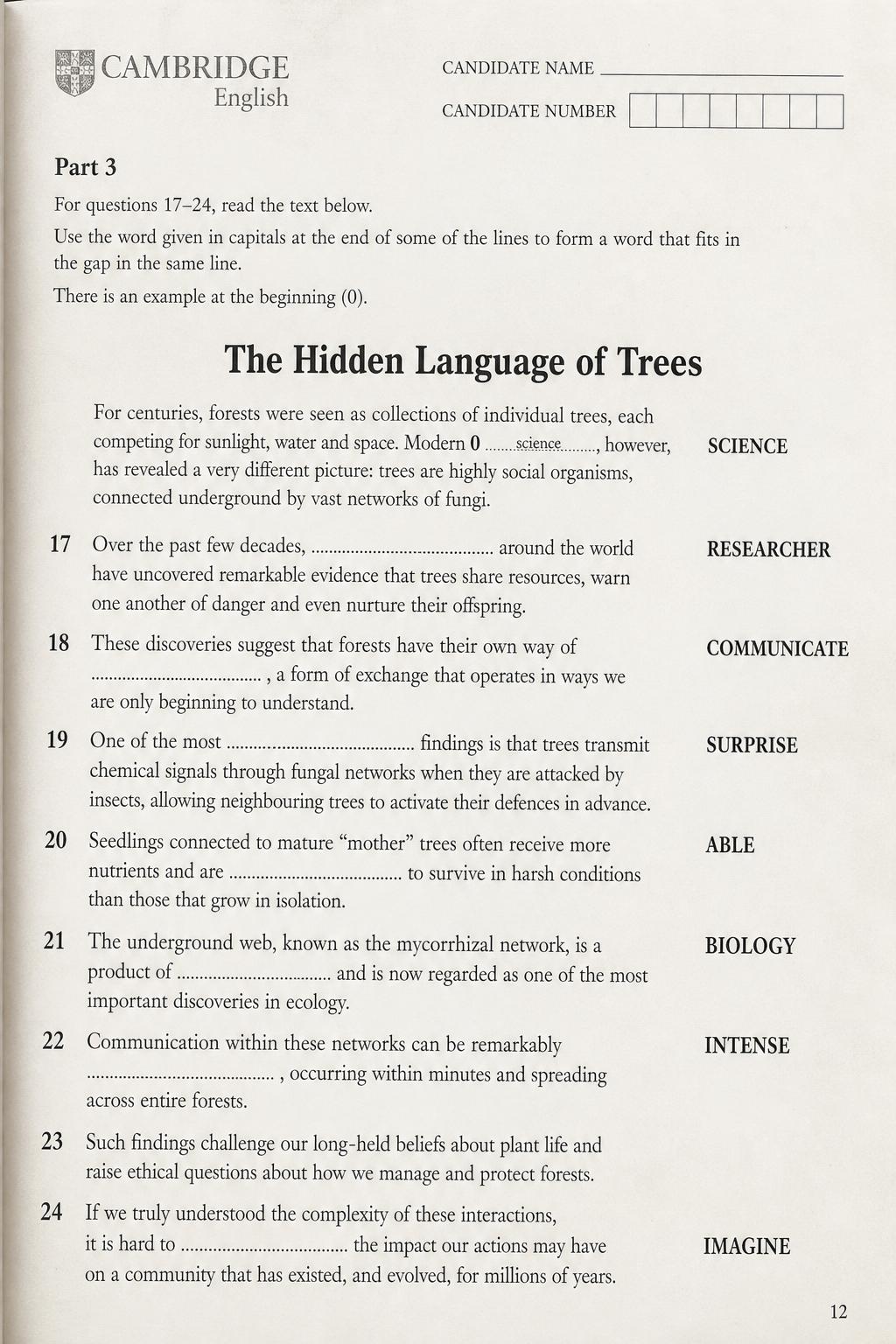
Discuss in pairs
In pairs, decide the word class of each gap BEFORE filling it. Justify your choice from the surrounding grammar.
CAE R&UoE Part 3 — Word Formation, in depth
Strategy
- 1.READ the whole text for gist (30 seconds) — context decides form.
- 2.FOR EACH GAP: cover the root, read the sentence, decide the WORD CLASS needed (noun / verb / adjective / adverb).
- 3.FORM the root in that class — including any prefix the meaning needs (negative, repetition, degree).
- 4.Check NUMBER (singular/plural) and TENSE (present/past) before moving on.
- 5.Sometimes the original word fits — don't transform for the sake of it.
Example
Root: ABLE. Sentence: 'Seedlings are ____ to survive in harsh conditions.' Word class needed: adjective (after 'are', describing the seedlings). Form: 'better able' (the comparative adjective phrase the meaning calls for). Spelling: a-b-l-e.
Practice · Section 9
7 minFill in the blank
Question 1.DECIDE → 'She made a quick ____ to apply.'
Question 2.COMMUNICATE → 'The team has excellent ____ skills.'
Question 3.ABLE → 'I admire her ____ to stay calm under pressure.'
Question 4.SURPRISE → '____ , he agreed without arguing.'
Question 5.BIOLOGY → 'There is a ____ explanation for the behaviour.'
Question 6.IMAGINE → 'The novel shows real ____.'
Question 7.INTENSE → 'The training ____ over the final week.'
Question 8.RESEARCH → 'They are still ____ the causes of the disease.'
Q1.Form a noun from ABLE that means 'the quality of being able'.
Q2.Form an adverb from SURPRISE.
Q3.Form a noun from LONG (the internal-change noun — NOT 'longness').
Q4.Form the negative adjective from POSSIBLE (with prefix).
Q5.Form a noun from HIGH (internal change).
Writing · Section 10
4 minPut it in writing
Your task
Pick ANY five words from this lesson. For each one, write its full four-form family (noun · verb · adjective · adverb), mark stress on each form, and add ONE example sentence using each. Total: ~20 family members, ~20 example sentences.
- • Use only words you genuinely want to add to your active range — no padding.
- • Mark stress with CAPS on the stressed syllable: phoTOgraphy.
- • If a form doesn't exist (e.g. no adverb), write 'none' — don't invent it.
Before you submit
- ☐ Five different roots chosen.
- ☐ Each root has its full available family listed.
- ☐ Stress is marked on every form.
- ☐ Each form has an example sentence (NOT just a definition).
Show model answer
Sample for DECIDE: deCIDE (v) — 'I decided to apply.' / deCIsion (n) — 'It was a tough decision.' / deCIsive (adj) — 'She was decisive in the meeting.' / deCIsively (adv) — 'They acted decisively.' / negative: inDEcisive (adj) — 'He's quite indecisive when tired.' Full family logged, stress marked, five live sentences.
Make it a real conversation
Defend-the-form pairs. Student A reads aloud a sentence with a gap and a root in capitals. Student B says (a) the WORD CLASS the gap needs, (b) the form of the root, and (c) one reason from the surrounding grammar that proves the class. Swap each round. 6 minutes.
Useful phrases
- The gap needs a [noun / verb / adjective / adverb] because…
- The word before the gap is 'of' / 'are' / 'most' — that points to a…
- From ROOT, the form has to be…
- I also need a negative prefix here because…
- It's plural because the verb is plural.
- The original word fits — no transformation needed.
- Watch out, this is an internal-change pair — not the regular -ness form.
- The stress shifts when we add this suffix — let me say it again.
- ACOMMUNICATE → 'Forests have their own way of ____.'
- B_______________
- ASURPRISE → 'One of the most ____ findings is that trees share resources.'
- B_______________
- AABLE → 'Connected seedlings are ____ to survive harsh conditions.'
- B_______________
Optional · Teacher-led
Teacher Activities
Two extensions for stronger groups or longer sessions. ~22 min total
Homework · Section 12
Take-homeTake it home
Complete the 8 Part 3 gaps from the visual stimulus page ('The Hidden Language of Trees'). For each one, also write in brackets the WORD CLASS you identified before forming the word.
questions · Eight gaps to complete
- 17. Over the past few decades, ____ around the world have uncovered remarkable evidence. (RESEARCHER)
- 18. These discoveries suggest that forests have their own way of ____ . (COMMUNICATE)
- 19. One of the most ____ findings is that trees transmit chemical signals. (SURPRISE)
- 20. Seedlings connected to mature trees are ____ to survive in harsh conditions. (ABLE)
- 21. The underground web is a product of ____ co-evolution. (BIOLOGY)
- 22. Communication within these networks can be remarkably ____ . (INTENSE)
- 23. Such findings challenge our long-held beliefs about plant life. (no transformation — example/control)
- 24. It is hard to ____ the impact our actions may have. (IMAGINE)
Build a 'family map' notebook page. Pick 10 C1 roots from your own course materials. For each root, log its four-form family (noun / verb / adjective / adverb) PLUS its main negative form. Mark stress on every form. Aim for 40+ active words on one page.
vocab list · Suggested roots to start (pick any 10)
- ANALYSE, CRITIC, ECONOMY, ENVIRONMENT, GLOBAL, IDENTITY, INTERPRET, JUSTICE, NATURE, POLITIC, SCIENCE, SIGNIFY, SOCIETY, TECHNOLOGY, UNIVERSE
Find a short article online (~500 words). Pick 5 nouns and rewrite each one as a sentence using a DIFFERENT word-class form of the same root. (e.g. find the noun 'decision' → rewrite using the verb 'decide' or the adjective 'decisive'.)
prompts · For each of 5 nouns
- Copy the original sentence (with the noun in bold).
- Identify the root word.
- Rewrite the sentence using a different form of that root — keeping the meaning.
- State which form you used (noun / verb / adjective / adverb).
Record yourself (60–90 seconds) walking through ONE Part 3 gap from start to finish. Show — out loud — how you identify the word class, decide the form, and check for prefix / number / spelling before writing.
prompts · Cover, in this order
- Read the sentence aloud and name the root in capitals.
- Identify the WORD CLASS the gap needs and the grammar reason.
- Form the root in that class.
- Check whether a prefix is needed for meaning.
- Check number (singular/plural) and tense.
- Say the final word with correct stress.
Recap · Section 13
Wrap-upWhat you've learned
- Part 3 tests vocabulary DEPTH — how many forms of one root you can produce — not breadth.
- Every C1 root has up to four core forms: noun · verb · adjective · adverb. Store them together.
- The gap's surrounding grammar tells you which WORD CLASS to write. Identify the class FIRST, the form second.
- Use the suffix kit: noun (-tion / -ment / -ity / -ness), adjective (-ous / -al / -ive / -able), verb (-ise / -ify / -en), adverb (-ly).
- Watch the traps: prefix for meaning (im-, un-, dis-) and internal change (long → length, deep → depth).
Need more practice?
Extra Practice for the task types and language in this lesson. Optional — it never changes your progress.
Lesson complete
Mark this lesson done to save your progress.